The abbreviation VD is widely seen in text messages, social media, chats, and even educational or medical contexts. While it may seem simple, its meaning changes depending on the situation. Understanding the VD meaning helps you interpret conversations accurately and use the term correctly when needed.
VD can appear in casual texting, historical references, or medical discussions, which makes it a versatile abbreviation. This article explains all common meanings, examples, and contexts of VD in a clear, detailed way.
What Does VD Mean
Definition
VD is an abbreviation that has multiple meanings depending on context:
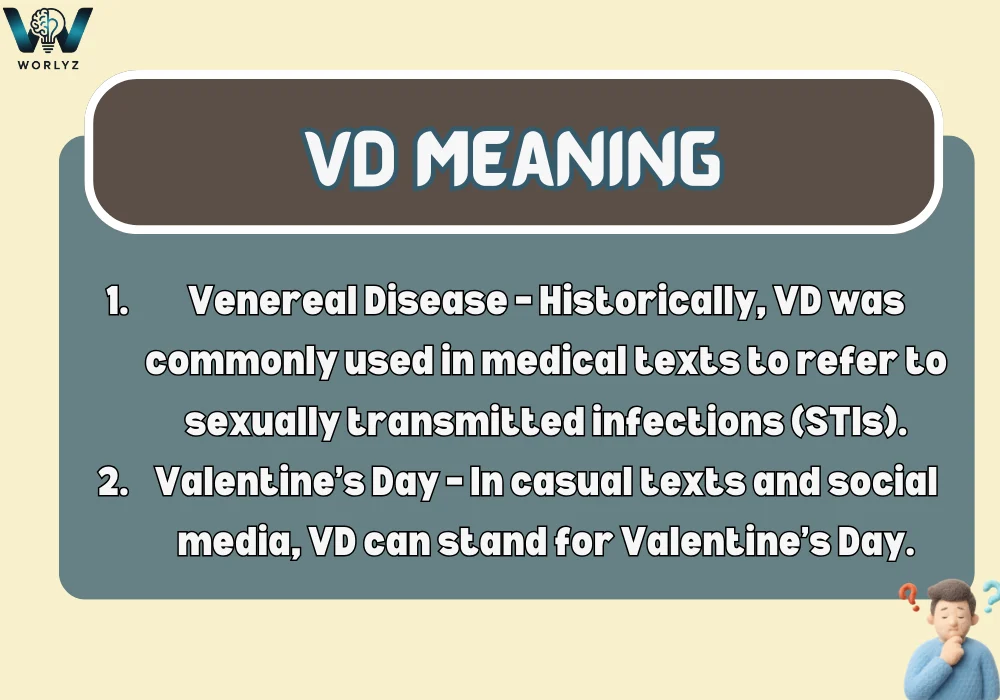
- Venereal Disease – Historically, VD was commonly used in medical texts to refer to sexually transmitted infections (STIs).
- Valentine’s Day – In casual texts and social media, VD can stand for Valentine’s Day.
- Various Other Meanings – In niche or informal contexts, VD might represent other phrases like video display or verbal discussion, though these are less common.
The meaning always depends on the conversation, tone, and audience.
Origin of VD
The abbreviation VD originally became popular in the early 20th century as a shorthand for venereal disease in medical literature and public health campaigns. Over time, the abbreviation also appeared in casual culture to refer to Valentine’s Day, especially in texting and social media.
The dual meaning of VD highlights the importance of context when interpreting abbreviations.
Different Meanings of VD Based on Context
VD as Venereal Disease (Medical)
In medical and historical contexts, VD refers to sexually transmitted infections such as syphilis, gonorrhea, or chlamydia. The term was widely used in the 1900s before modern terminology like STI or STD became standard.
Examples:
- The public health campaign focused on preventing VD.
- Early 20th-century doctors tracked cases of VD in the city.
This usage is more formal and mostly historical today, replaced by terms like STI.
VD as Valentine’s Day (Casual/Modern)
In texting, chats, and social media, VD often refers to Valentine’s Day, a day celebrating love and affection on February 14th.
Examples:
- Can’t wait for VD plans with my partner!
- Sending sweet messages for VD 💌
This usage is very common among younger audiences and casual conversations.
VD in Other Contexts
Sometimes, VD can be used in less common contexts, such as:
- Video Display – in technology or electronics
- Verbal Discussion – in educational or professional notes
These meanings are rare and typically inferred from the surrounding context.
VD Meaning in Simple Language
In modern conversation, VD can mean:
- Venereal Disease – health-related, historical term
- Valentine’s Day – love and relationships context
- Other niche meanings – technology or informal notes
The key is always understanding the situation where the abbreviation is used.
Examples of VD in Conversations
Texting Example (Valentine’s Day)
I’m planning a surprise for VD this year!
Historical Example (Medical)
Doctors warned citizens about the spread of VD in the early 1900s.
Casual/Informal Example
Our school held a VD celebration with chocolates and cards.
These examples show how VD shifts meaning based on context.
VD Compared to Similar Abbreviations
Understanding VD becomes easier when compared to related abbreviations.
| Abbreviation | Meaning | Key Difference |
|---|---|---|
| VD | Venereal Disease / Valentine’s Day | Meaning depends on context |
| STI | Sexually Transmitted Infection | Medical and modern |
| STD | Sexually Transmitted Disease | Formal medical term |
| V-Day | Valentine’s Day | Alternative casual shorthand |
| VD | Video Display | Niche, technical usage |
VD is versatile but relies heavily on context to avoid confusion.
Common Mistakes or Misunderstandings
Misinterpreting VD Without Context
VD can refer to either a medical condition or a romantic holiday. Misreading the situation can cause embarrassment or misunderstanding.
Assuming VD Always Means Medical
Many younger people today primarily recognize VD as Valentine’s Day in texts, not the old medical usage.
Using VD in Professional Settings
Using VD to mean Valentine’s Day may not be appropriate in formal contexts. Similarly, using VD to describe venereal diseases is outdated and better replaced with STI or STD.
Cultural and Historical Significance
The medical meaning of VD reflects early public health efforts and historical awareness campaigns. Hospitals, schools, and governments used posters and pamphlets to educate people about prevention.
The Valentine’s Day meaning reflects modern pop culture and casual communication. Today, VD often appears in memes, social media captions, and texting slang.
Related Words and Abbreviations
When exploring VD, you may also see:
- STI (Sexually Transmitted Infection)
- STD (Sexually Transmitted Disease)
- V-Day (Valentine’s Day)
- Venereal infection
- Love day
Understanding these terms helps clarify which meaning of VD is intended in any conversation.
FAQs:
What does VD mean in texting?
In texting, VD often refers to Valentine’s Day, especially when talking about messages, gifts, or plans.
Was VD ever a medical term?
Yes, historically VD meant venereal disease, which included sexually transmitted infections like syphilis and gonorrhea.
Is VD still used in medical settings?
Not really. Modern medicine prefers STI or STD instead of VD.
Can VD mean other things?
Yes, VD can mean niche things like video display or verbal discussion, depending on context.
How do I know which meaning of VD is correct?
The meaning depends on context: medical texts, historical discussion, or casual conversation about Valentine’s Day.
Conclusion:
The VD meaning varies greatly depending on context. Historically, it was a serious medical abbreviation for venereal disease, but today it is widely recognized as shorthand for Valentine’s Day in casual texting and social media. VD can also have niche meanings in technology or professional notes, which shows its versatility.
Understanding the correct meaning of VD ensures you interpret conversations accurately and communicate clearly. Whether discussing historical medical topics, planning VD celebrations, or reading social media captions, knowing the context is key.

John is the founder and primary content creator of Worlyz. He has a strong passion for explaining word meanings, language concepts, slang terms, and educational topics in a clear and simple way. John focuses on creating well researched, reader friendly content that helps users easily understand complex words and ideas. Through Worlyz, his goal is to make learning meanings and concepts straightforward and accessible for everyone.