The word for is one of the most common and versatile words in English. It appears in sentences, questions, and everyday conversations, yet its meaning can change depending on context. Understanding the for meaning in English grammar is essential for clear communication, whether you are writing essays, chatting online, or learning English as a second language.
In English, for can function as a preposition, conjunction, or part of idiomatic expressions. Its usage spans from expressing purpose, time, reason, and benefit to indicating relationships between ideas. This guide provides an in-depth look at all the ways for is used, with examples, comparisons, and tips to avoid mistakes.
What Does For Mean
Definition
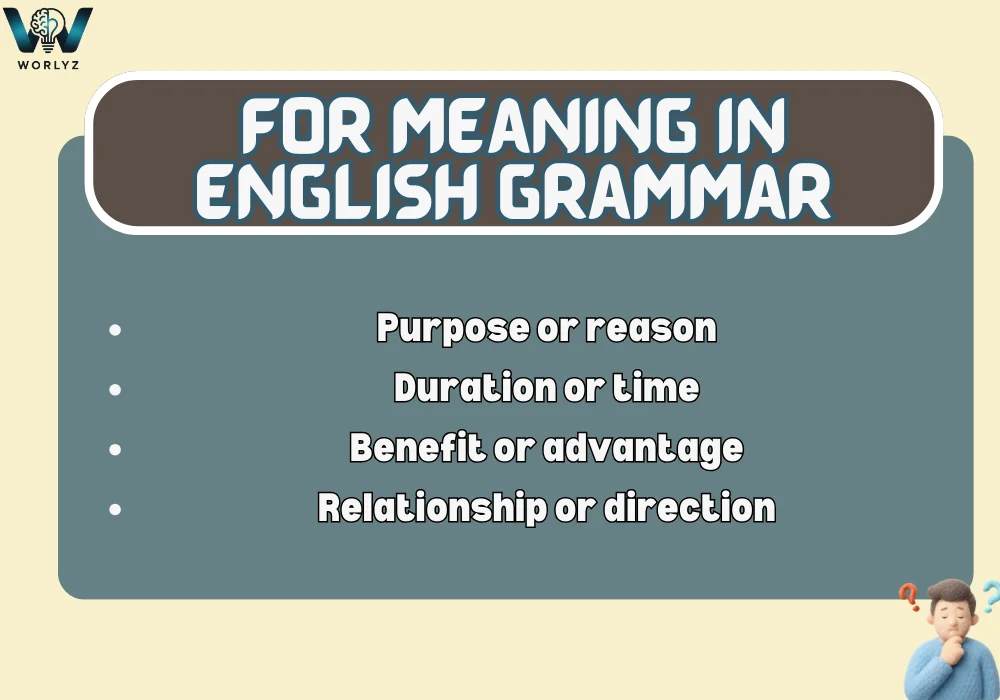
In English grammar, for generally indicates:
- Purpose or reason
- Duration or time
- Benefit or advantage
- Relationship or direction
At its core, for helps connect words, phrases, or clauses to explain why, how long, or for whom something happens.
Origin and Background
The word for comes from Old English for, which originally meant “on behalf of” or “in place of.” Over centuries, its meaning expanded, and it became a standard preposition used to indicate purpose, cause, and benefit.
Today, for is one of the most frequently used words in English and is essential for constructing clear, logical sentences.
Different Uses of For in English Grammar
1. For Expressing Purpose or Reason
For can explain why something is done or the purpose of an action.
Examples:
- I bought a gift for her birthday.
- This tool is used for cutting wood.
- He studies hard for success in life.
In all these examples, for connects the action to its purpose.
2. For Expressing Benefit or Advantage
For can indicate who benefits from an action or who is affected positively.
Examples:
- This meal is prepared for the guests.
- Exercise is good for your health.
- She did it for her family.
Here, for highlights the recipient or the beneficiary of an action.
3. For Indicating Duration of Time
For can be used to describe how long something lasts.
Examples:
- I have lived here for five years.
- He slept for eight hours last night.
- They played football for two hours.
In this context, for is often followed by a period of time (hours, days, weeks, etc.).
4. For Expressing Cause or Reason
For can also explain the reason behind a situation, often in formal or literary contexts.
Examples:
- He is praised for his courage.
- She was fined for breaking the rules.
- They were rewarded for their hard work.
Here, for connects an action to its cause or justification.
5. For Indicating Relationship, Direction, or Purpose
For can show relationships or the direction of an action.
Examples:
- This letter is for you.
- I am heading for the station.
- Rules for students must be followed.
It can describe physical direction, ownership, or a role in a relationship.
For Meaning in Simple Language
In everyday terms, for can mean:
- Because of
- To help or benefit
- During or throughout
- Directed at someone or something
For is often easy to understand in context, but its meaning changes depending on how it’s used in a sentence.
Examples of For in Conversations
Everyday Conversation Example
I got a ticket for the concert tonight.
Professional Context Example
This software is useful for project management.
Emotional Context Example
She made a card for her best friend.
Time-Related Example
I have been waiting for two hours.
These examples demonstrate the flexibility of for in different situations.
For Compared to Similar Prepositions
Understanding for becomes easier when compared to similar words:
| Preposition | Example | Key Difference |
|---|---|---|
| For | I work for a company | Indicates purpose, benefit, or duration |
| To | I gave the book to her | Focuses on direction or recipient |
| Of | A friend of mine | Shows possession or association |
| With | I am working with him | Indicates accompaniment or tool |
| About | We talked about the project | Focuses on topic or subject |
While these prepositions can sometimes overlap in meaning, for emphasizes purpose, benefit, or duration.
Common Mistakes or Misunderstandings
Confusing For and To
- Incorrect: I gave a gift for her.
- Correct: I gave a gift to her.
Use to for direction or transfer, and for for purpose or benefit.
Using For Incorrectly with Time
- Incorrect: I stayed here since two hours.
- Correct: I stayed here for two hours.
For expresses duration, not starting points.
Misusing For with Reasons
- Incorrect: He was punished to breaking the rule.
- Correct: He was punished for breaking the rule.
For links actions to reasons or causes.
Idiomatic Expressions Using For
For appears in many common expressions in English:
- For example – used to introduce a specific instance
- For sure – meaning certainly or definitely
- For a while – indicating a short period
- For the sake of – indicating purpose or benefit
- For good – meaning permanently
These idioms show the flexibility and usefulness of for in everyday language.
For in Literature, Music, and Speech
The word for is extremely common in books, songs, and speeches because it helps connect ideas naturally.
Examples:
- “For every action, there is an equal and opposite reaction.”
- “I will sing for you all night.”
- “For love and courage, we stand together.”
Its frequent use makes it one of the most important prepositions in English grammar.
FAQs:
What does for mean in English grammar?
For is a preposition that usually shows purpose, benefit, time, reason, or direction in a sentence.
Can for indicate duration of time?
Yes, for is commonly used to show how long something lasts, e.g., “I have been studying for three hours.”
Is for the same as to?
Not exactly. For shows purpose or benefit, while to indicates direction, transfer, or movement.
How is for used in idioms?
For appears in expressions like for example, for good, for a while, and for the sake of, often indicating purpose or emphasis.
Can for express reason?
Yes, for is used to explain cause or justification, e.g., “He was praised for his efforts.”
Conclusion:
The for meaning in English grammar is versatile and essential. It can describe purpose, benefit, duration, reason, or direction, making it a crucial word for clear communication.
Understanding how to use for correctly allows you to write better, speak more naturally, and avoid common mistakes in grammar. Its frequent use in conversation, literature, and professional writing makes it one of the foundational prepositions in English. By mastering for, you can express ideas about why, how long, or for whom something happens with confidence.

Alex is the owner and founder of Worlyz. He is passionate about explaining word meanings, language concepts, slang terms, and educational topics in a clear and simple manner. Alex focuses on creating high quality, well researched, and user focused content that helps readers understand complex words easily. Through Worlyz, his goal is to make learning language meanings and concepts accessible and reliable for everyone.