The words advise and advice are often confused, even by native speakers. They sound similar and are related, but they have different grammatical roles and slightly different meanings. Understanding the advise vs advice meaning helps you write and speak correctly, avoid misunderstandings, and communicate clearly in both professional and casual settings.
This guide breaks down their definitions, usage, examples, and common mistakes so you can confidently choose the right word every time.
What Does Advise vs Advice Mean
Advise Definition
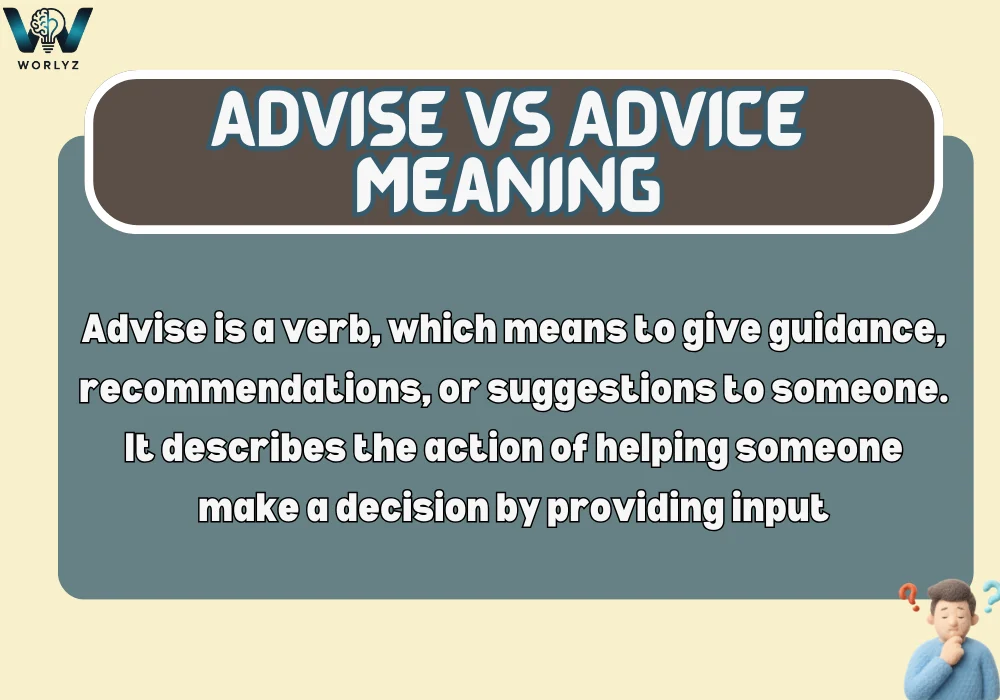
Advise is a verb, which means to give guidance, recommendations, or suggestions to someone. It describes the action of helping someone make a decision by providing input.
Example:
- I advise you to study before the exam.
- The teacher advised the students to read more books.
Advice Definition
Advice is a noun, which means the guidance, recommendations, or suggestions given to someone. It is the actual content or information that someone provides when they advise.
Example:
- She gave me some excellent advice about my career.
- His advice helped me make the right decision.
Key Difference in Simple Terms
| Word | Part of Speech | Meaning | Example |
|---|---|---|---|
| Advise | Verb | To give guidance | I advise you to take a break. |
| Advice | Noun | The guidance given | Her advice was very helpful. |
In short: you advise someone, and they receive advice.
How Advise vs Advice Is Used
Using Advise in Sentences
Since advise is a verb, it is always used with a subject performing the action.
Examples:
- I advise caution when using this software.
- Doctors advise patients to exercise regularly.
- Can you advise me on how to start a business?
Notice how advise is always an action performed by someone.
Using Advice in Sentences
Advice is a noun, so it represents the guidance or suggestion itself.
Examples:
- My father’s advice helped me succeed.
- Let me give you some advice about studying effectively.
- The financial advisor’s advice was very practical.
Advice can be singular or uncountable, but sometimes we say pieces of advice for clarity:
- She gave me three important pieces of advice.
Common Mistakes With Advise and Advice
Mistake 1: Using Advice as a Verb
Incorrect: I advice you to read this book.
Correct: I advise you to read this book.
Mistake 2: Using Advise as a Noun
Incorrect: Her advise was very useful.
Correct: Her advice was very useful.
Mistake 3: Confusing Pronunciation
- Advise (verb) – sounds like ad-VIZE
- Advice (noun) – sounds like ad-VICE
The subtle difference in pronunciation helps identify the correct usage.
Tips to Remember the Difference
- Advise → Action (Verb)
Think: “I advise someone to do something.” - Advice → Thing (Noun)
Think: “The advice I received was helpful.” - Mnemonic Trick
- Advise ends with -se, which can remind you of act (both involve action).
- Advice ends with -ce, which can remind you of content (the guidance itself).
Advise vs Advice in Professional Contexts
In business, education, and professional writing, confusing these two words can make communications look unprofessional.
- Correct professional usage:
- “Our consultant advised us to reduce costs.”
- “The consultant’s advice improved our strategy.”
- Incorrect usage:
- “Our consultant advice us to reduce costs.”
- “The consultant advised improved our strategy.”
Clear understanding ensures proper tone and grammar in emails, reports, or presentations.
Advise vs Advice in Everyday Conversation
Even in casual speech, people often confuse the two. Understanding the difference helps you avoid awkward mistakes.
Examples:
- Casual: Can you advise me what to do? ✅
- Casual: Can you advice me what to do? ❌
- Casual: Thanks for your advice on my problem ✅
- Casual: Thanks for your advise on my problem ❌
Using the correct word improves clarity and shows attention to detail.
Related Words and Expressions
Other words related to advice and advise include:
- Counsel (noun/verb) – formal guidance
- Suggest (verb) – a milder form of advise
- Recommendation (noun) – formal advice
- Guidance (noun) – direction or help
- Tip (noun) – informal advice
These words are sometimes used interchangeably depending on tone and context.
Comparison Table: Advise vs Advice in Detail
| Feature | Advise | Advice |
|---|---|---|
| Part of Speech | Verb | Noun |
| Meaning | To give guidance or suggestions | The guidance or suggestions given |
| Example Sentence | I advise you to take notes. | The advice you gave me was helpful. |
| Formality | Can be used in formal and informal contexts | Can be used in formal and informal contexts |
| Common Mistakes | Using as a noun | Using as a verb |
| Pronunciation | ad-VIZE | ad-VICE |
This table makes the difference clear for quick reference.
FAQs:
What is the difference between advise and advice?
Advise is a verb meaning to give guidance, while advice is a noun meaning the guidance itself.
Can I use advice as a verb?
No, advice is always a noun. The correct verb form is advise.
Is advise more formal than advice?
Advise is a verb used in both formal and casual contexts; advice is a noun and can be formal or informal depending on context.
How do I remember advise vs advice?
Think: Advise → action (verb), Advice → content (noun). Use pronunciation and the mnemonic: -se = act, -ce = content.
Can advice be plural?
Advice is usually uncountable. To indicate multiple suggestions, say pieces of advice.
Conclusion:
The advise vs advice meaning is simple once you remember the main distinction: advise is the action of giving guidance, and advice is the guidance itself. Both words are essential in English communication, and using them correctly improves clarity in writing and speech.
By understanding their differences, pronunciation, and proper contexts, you can confidently use advise and advice in professional, casual, or academic settings. Correct usage shows attention to detail and helps avoid confusion in everyday conversations.

John is the founder and primary content creator of Worlyz. He has a strong passion for explaining word meanings, language concepts, slang terms, and educational topics in a clear and simple way. John focuses on creating well researched, reader friendly content that helps users easily understand complex words and ideas. Through Worlyz, his goal is to make learning meanings and concepts straightforward and accessible for everyone.