The phrase sour grapes is commonly used in everyday conversations, social media, and even professional discussions. At first glance, it may sound like it has something to do with fruit, but its real meaning is completely different. Understanding the sour grapes meaning helps you recognize when someone is making excuses or downplaying something they could not achieve.
This expression is especially useful in modern communication, where people often react to failure or disappointment in subtle ways. Knowing how and when to use sour grapes can improve your understanding of conversations and human behavior.
What Does Sour Grapes Mean
Definition
Sour grapes refers to a situation where someone pretends something is not valuable or desirable because they could not get it.
In simple terms, it means:
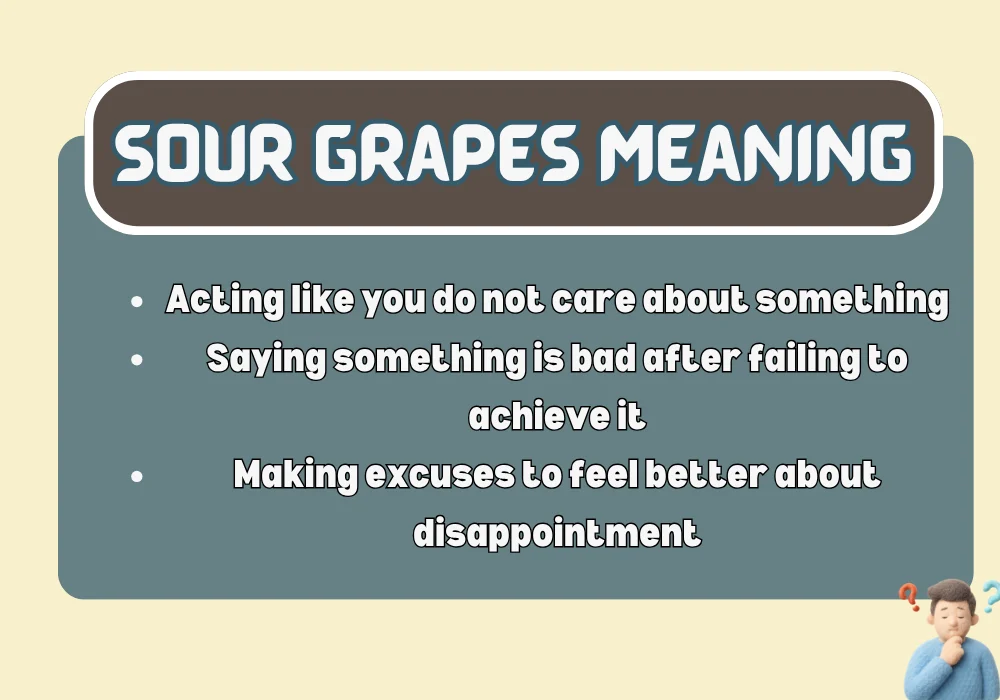
- Acting like you do not care about something
- Saying something is bad after failing to achieve it
- Making excuses to feel better about disappointment
Origin of the Phrase
The phrase comes from one of Aesop’s Fables, specifically the story of The Fox and the Grapes. In this story, a fox tries to reach a bunch of grapes but cannot. Instead of admitting failure, the fox walks away saying the grapes are probably sour anyway.
This story gave rise to the expression sour grapes, which is now widely used to describe similar behavior.
How Sour Grapes Is Used in Everyday Language
Sour Grapes as a Behavioral Reaction
Sour grapes is often used to describe how people react when they feel disappointed or rejected.
Common situations include:
- Not getting a job
- Losing a competition
- Being rejected in relationships
- Missing an opportunity
Instead of accepting the outcome, a person may pretend it was not worth it.
Example:
He said the job was boring anyway, but it sounded like sour grapes.
Sour Grapes in Social Situations
The phrase is frequently used in casual conversations to point out someone’s attitude.
Examples:
- She said the restaurant was overrated after not getting a reservation
- He called the event pointless because he was not invited
In both cases, the reaction reflects disappointment disguised as criticism.
Sour Grapes Meaning in Simple Language
In everyday terms, sour grapes means:
- Pretending something is not good after failing to get it
- Hiding disappointment by criticizing
- Protecting your feelings by changing your opinion
It is often linked to pride and emotional defense.
Examples of Sour Grapes in Conversations
Everyday Conversation Example
She said the award did not matter, but it felt like sour grapes.
Workplace Example
After missing the promotion, he claimed the role was too stressful anyway. That is sour grapes.
Social Media Example
Calling something overrated just because you could not experience it is classic sour grapes.
Relationship Example
He said he never liked her after she rejected him, which sounded like sour grapes.
These examples show how the phrase applies to real-life situations.
Sour Grapes Compared to Similar Expressions
Understanding sour grapes becomes easier when compared with similar phrases.
| Expression | Meaning | Key Difference |
|---|---|---|
| Sour grapes | Pretending something is not good after failing | Focuses on disappointment |
| Jealousy | Wanting what others have | Focuses on desire |
| Excuse making | Justifying failure | Broader concept |
| Denial | Refusing to accept reality | Stronger emotional reaction |
| Bitterness | Feeling resentment | More long-term emotion |
Sour grapes is usually a quick emotional reaction rather than a deep feeling.
Psychological Meaning of Sour Grapes
Sour grapes is linked to a psychological concept called cognitive dissonance. This happens when a person feels uncomfortable because their desires and reality do not match.
To reduce this discomfort, they change their attitude.
For example:
- Desire: I want that opportunity
- Reality: I did not get it
- Reaction: It was not worth it anyway
This mental adjustment helps protect self-esteem.
When and How to Use Sour Grapes Correctly
Appropriate Usage
Use sour grapes when:
- Someone dismisses something after failing to get it
- A reaction clearly comes from disappointment
- You want to describe defensive behavior
Situations to Avoid
Avoid using sour grapes when:
- Someone genuinely changes their opinion
- There is valid criticism
- The situation is sensitive or emotional
Using it incorrectly can sound judgmental.
Common Mistakes or Misunderstandings
Thinking Sour Grapes Means Simple Dislike
It is not just about disliking something. It specifically involves disappointment or failure.
Using It Without Context
The phrase only works when there is a clear connection to not achieving something.
Confusing It With Jealousy
Jealousy is about wanting something, while sour grapes is about pretending not to want it anymore.
Sour Grapes in Modern Usage
Today, sour grapes is widely used in:
- Social media comments
- Workplace discussions
- Everyday conversations
- Online debates
It is often used to call out behavior in a light or humorous way.
Related Words and Expressions
When learning the sour grapes meaning, you may also encounter:
- Making excuses
- Being bitter
- Downplaying success
- Defensive attitude
- Saving face
These expressions are closely connected in meaning.
FAQs:
What does sour grapes mean in simple words?
Sour grapes means pretending something is not good because you could not get it.
Where does the phrase sour grapes come from?
It comes from a story in Aesop’s Fables where a fox fails to reach grapes and claims they are sour.
Is sour grapes always negative?
Yes, it usually describes a negative or defensive reaction to disappointment.
How do you use sour grapes in a sentence?
You can say his comments sounded like sour grapes after he lost the competition.
Is sour grapes the same as jealousy?
No, jealousy is wanting something others have, while sour grapes is pretending you do not want it after failing to get it.
Conclusion:
The sour grapes meaning reflects a common human reaction to disappointment. Instead of accepting failure, people sometimes protect their feelings by pretending something was not worth having in the first place.
Understanding this phrase helps you recognize emotional behavior in conversations and use the expression correctly. It is a simple but powerful way to describe how people deal with unmet expectations.
Feel free to share your favorite idiom or phrase and explore its meaning further.

John is the founder and primary content creator of Worlyz. He has a strong passion for explaining word meanings, language concepts, slang terms, and educational topics in a clear and simple way. John focuses on creating well researched, reader friendly content that helps users easily understand complex words and ideas. Through Worlyz, his goal is to make learning meanings and concepts straightforward and accessible for everyone.