If you have ever looked at an eye prescription, medical report, or ophthalmology chart, you may have noticed the abbreviation OD next to eye measurements. Many people find it confusing at first and wonder what it actually stands for. Understanding the OD meaning eye helps you read eye reports correctly and avoid misunderstandings about your vision or treatment.
This term is widely used by eye doctors, optometrists, and medical professionals, and it also appears in online health discussions and vision-related content.
What Does OD Mean in Eye Terms
Definition
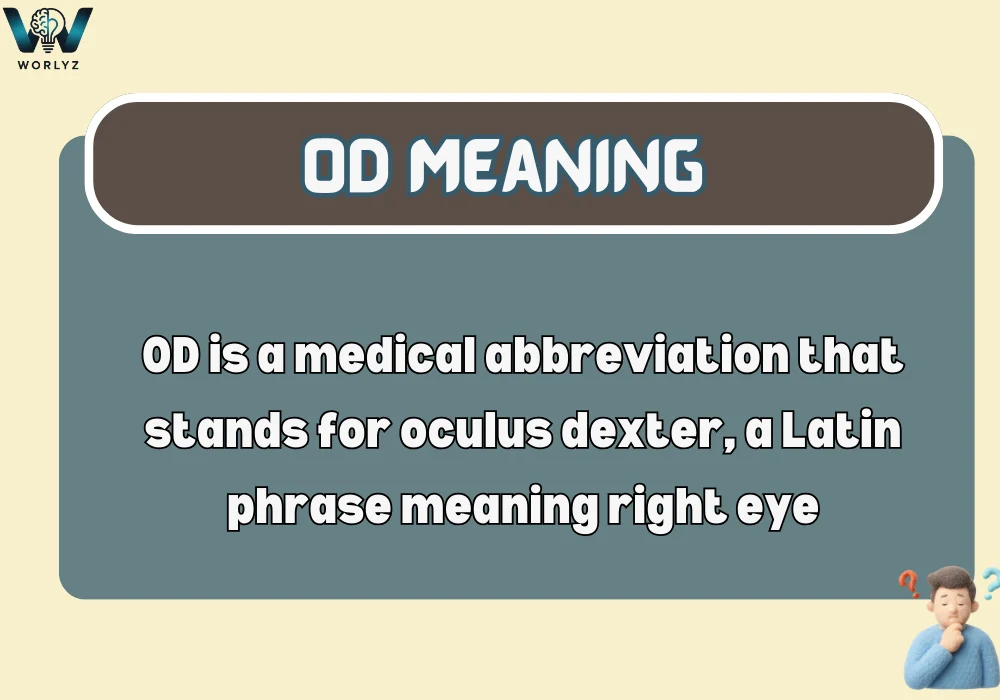
OD is a medical abbreviation that stands for oculus dexter, a Latin phrase meaning right eye.
In eye care, OD is used to clearly identify information related to the patient’s right eye.
Origin of the Term
The abbreviation OD comes from Latin, which has been traditionally used in medical terminology for centuries. Using Latin terms helps maintain clarity and consistency across different languages and regions.
- Oculus means eye
- Dexter means right
Together, oculus dexter refers specifically to the right eye.
How OD Is Used in Eye Prescriptions
OD is most commonly seen in eyeglass and contact lens prescriptions.
OD in Vision Prescriptions
On a standard prescription, you may see:
- OD for the right eye
- OS for the left eye
- OU for both eyes
Each eye often has different measurements, so using OD helps ensure the correct lens or treatment is applied.
Example of OD on a Prescription
A typical prescription might look like this:
- OD: -2.00 sphere
- OS: -1.50 sphere
This means the right eye and left eye require different corrective strengths.
OD Meaning Eye in Simple Language
In everyday terms, OD simply means right eye. Doctors use it to avoid confusion when discussing diagnoses, treatments, or prescriptions.
Think of it as a medical shortcut that saves time while keeping information accurate.
Where You Might See OD Used
OD appears in many eye-related settings, including:
- Eye exam reports
- Glasses and contact lens prescriptions
- Medical records
- Online vision forums
- Eye surgery documentation
Knowing this abbreviation makes it easier to understand what professionals are referring to.
Common Mistakes or Misunderstandings
Confusing OD with Overdose
One of the most common mistakes is thinking OD means overdose. In eye care, OD has nothing to do with medication overdose and refers only to the right eye.
Mixing Up OD and OS
OD refers to the right eye, while OS refers to the left eye. Mixing these up can lead to confusion when reading prescriptions.
Assuming Both Eyes Are the Same
Each eye can have different vision needs, which is why OD and OS are listed separately.
Related Eye Abbreviations
When learning the OD meaning eye, you may also encounter:
- OS meaning left eye
- OU meaning both eyes
- SPH meaning sphere
- CYL meaning cylinder
- AXIS meaning lens orientation
These abbreviations often appear together on eye prescriptions.
FAQs:
What does OD mean in eye prescriptions?
OD means oculus dexter, which refers to the right eye.
Is OD the right or left eye?
OD always refers to the right eye in medical and eye care terminology.
Why do doctors use OD instead of saying right eye?
OD provides a standardized and clear way to document eye information without confusion.
Can OD mean something different outside eye care?
Yes, in other contexts OD can mean overdose, but in eye care it strictly means right eye.
What is the difference between OD and OS?
OD refers to the right eye, while OS refers to the left eye.
Conclusion:
The OD meaning eye is simple once you understand it. OD stands for oculus dexter, which means right eye. It is a standard medical abbreviation used worldwide in eye care to ensure clarity and accuracy.
By knowing what OD means, you can read eye prescriptions, medical reports, and vision-related information with confidence. This small piece of knowledge can make a big difference in understanding your eye health.

John is the founder and primary content creator of Worlyz. He has a strong passion for explaining word meanings, language concepts, slang terms, and educational topics in a clear and simple way. John focuses on creating well researched, reader friendly content that helps users easily understand complex words and ideas. Through Worlyz, his goal is to make learning meanings and concepts straightforward and accessible for everyone.