The phrase caught up is one of those expressions that appears frequently in everyday conversations, social media, movies, and music. While it seems simple, its meaning can vary depending on context. Understanding the caught up meaning helps you interpret conversations accurately and use the phrase naturally in your own speech or writing.
Caught up can describe emotional states, situations, work, or social interactions. It is versatile, blending both literal and figurative usage. In this guide, we’ll explore all possible meanings, examples, comparisons, and common misunderstandings so you can fully grasp this phrase.
What Does Caught Up Mean
Definition
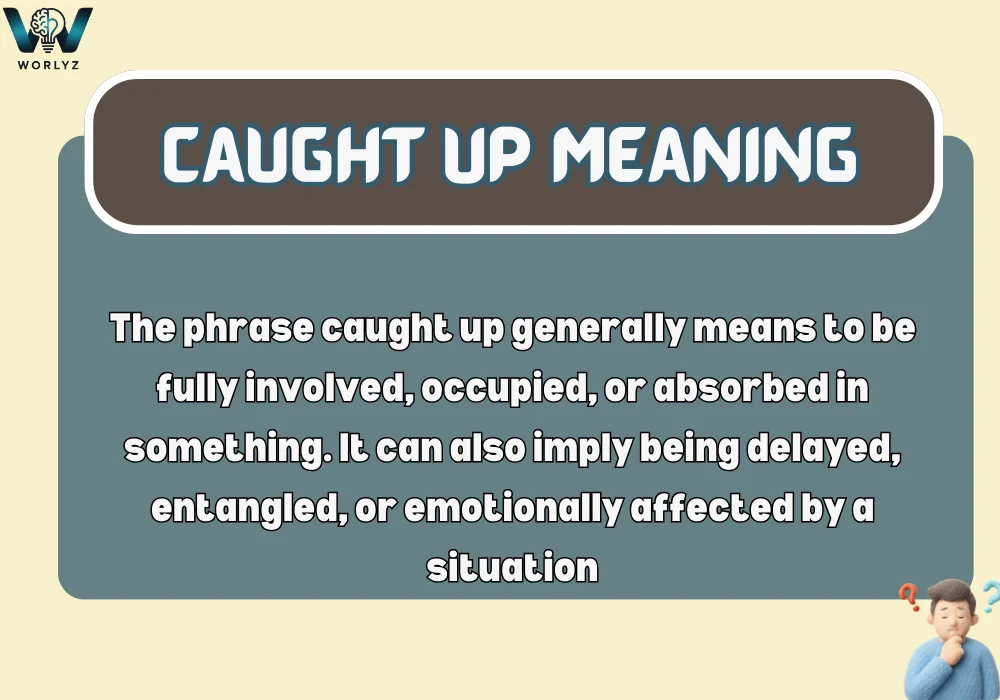
The phrase caught up generally means to be fully involved, occupied, or absorbed in something. It can also imply being delayed, entangled, or emotionally affected by a situation.
In essence, being caught up means your attention or time is taken over by something, either physically, mentally, or emotionally.
Origin and Background
The phrase “caught up” comes from the verb catch, which means to seize or grab. Over time, “caught up” evolved to express:
- Being engaged in activity
- Being absorbed emotionally
- Being delayed or hindered
This evolution allows the phrase to adapt to multiple contexts in modern English.
Different Meanings of Caught Up Based on Context
Literal Meaning: Physically Delayed or Involved
In its literal sense, caught up can mean being delayed or entangled in a physical task or situation.
Examples:
- I got caught up in traffic on my way to work.
- She was caught up in a crowd at the concert.
Here, caught up describes a situation that holds someone’s time or movement.
Figurative Meaning: Emotionally or Mentally Absorbed
Caught up can also describe being emotionally or mentally absorbed in something.
Examples:
- He got caught up in the excitement of the festival.
- Don’t get caught up in negative thoughts.
This usage often refers to strong feelings, attention, or involvement.
Slang and Casual Usage
In casual conversation or texting, caught up often means:
- Busy with something
- Focused on a task
- Overwhelmed by events
Examples:
- Sorry, I’ve been caught up with work all week.
- I got caught up watching a new series and lost track of time.
This modern usage is common in informal communication.
Caught Up Meaning in Simple Language
In everyday terms, caught up can mean:
- Busy or occupied
- Involved or absorbed in something
- Emotionally affected
- Temporarily delayed or distracted
It’s a versatile phrase that fits many contexts, from work and school to personal life and social interactions.
Examples of Caught Up in Conversations
Work-Related Example
I was caught up in meetings all day and couldn’t respond to emails.
Emotional Context Example
She got caught up in the joy of the reunion.
Casual Conversation Example
I got caught up with Netflix and forgot to call you.
Physical Situation Example
He got caught up in the crowd during the parade.
These examples show how the phrase can describe time, emotions, or involvement.
Caught Up Compared to Similar Words
Understanding caught up becomes easier when compared to related terms.
| Word | Meaning | Key Difference |
|---|---|---|
| Caught up | Absorbed, busy, or delayed | Flexible, figurative or literal |
| Engrossed | Fully absorbed mentally | Often positive or neutral |
| Overwhelmed | Unable to handle due to stress | Usually negative |
| Occupied | Busy with a task | More neutral, less emotional |
| Distracted | Attention diverted | Focus on loss of focus, not involvement |
Caught up is unique because it can describe both time involvement and emotional absorption.
Common Mistakes or Misunderstandings
Assuming Caught Up Always Means Busy
Caught up doesn’t always mean being busy. It can also mean being emotionally involved or temporarily delayed.
Confusing with Stressed
Being caught up is not always negative or stressful—it can be exciting or positive.
Overusing in Formal Writing
Caught up is casual in tone. In formal writing, phrases like “engaged in” or “occupied with” may be better alternatives.
Caught Up in Idioms and Expressions
The phrase also appears in common expressions:
- Get caught up in something – To become involved or absorbed
- Caught up in the moment – Fully absorbed by current emotions or events
- Caught up on something – Completing unfinished work or tasks
These idioms show how caught up can describe both emotional states and practical responsibilities.
Cultural and Popular Usage
Caught up is widely used in:
- Music lyrics
- Social media posts
- Casual conversations
- Movies and TV shows
Examples:
- Songs may say, “I got caught up in love.”
- Social media captions: “Caught up satiate-watching the latest show.”
The phrase communicates involvement, excitement, or being fully immersed in something relatable.
Related Words and Expressions
When learning the caught up meaning, you may also encounter:
- Engaged
- Absorbed
- Involved
- Overwhelmed
- Busy
Each word overlaps but has slightly different emphasis, such as emotional vs. time involvement.
FAQs:
What does caught up mean in simple words?
Caught up means being involved, busy, or absorbed in something physically, mentally, or emotionally.
Can caught up describe emotions?
Yes, it often refers to being emotionally absorbed in feelings, excitement, or events.
Is caught up formal English?
No, it’s mostly casual and used in spoken English, texting, or informal writing.
What is the difference between caught up and busy?
Caught up can imply emotional or mental absorption, not just being occupied with tasks.
Can caught up mean delayed?
Yes, it can describe being slowed or held back by circumstances, like traffic or crowds.
Conclusion:
The caught up meaning is versatile and context-dependent. It can describe physical delays, emotional absorption, mental engagement, or even being temporarily distracted. From work, school, and personal life to casual chats and music lyrics, caught up conveys involvement, immersion, or busyness.
Understanding how to use caught up in different situations helps you communicate more clearly, interpret conversations accurately, and sound natural in both casual and social contexts. Whether it’s being caught up in emotions, tasks, or fun activities, this phrase reflects how life often fully engages our attention.

John is the founder and primary content creator of Worlyz. He has a strong passion for explaining word meanings, language concepts, slang terms, and educational topics in a clear and simple way. John focuses on creating well researched, reader friendly content that helps users easily understand complex words and ideas. Through Worlyz, his goal is to make learning meanings and concepts straightforward and accessible for everyone.