The term civil war is widely used in history, politics, media, and even everyday conversations. While it may sound straightforward, its meaning carries deep historical, social, and emotional weight. Understanding the civil war meaning helps you better interpret historical events, news discussions, and even metaphorical uses of the phrase in modern language.
From major historical conflicts to symbolic usage in conversations, civil war represents internal division and struggle within a nation or group. This detailed guide explains the term in a clear and relatable way.
What Does Civil War Mean
Definition
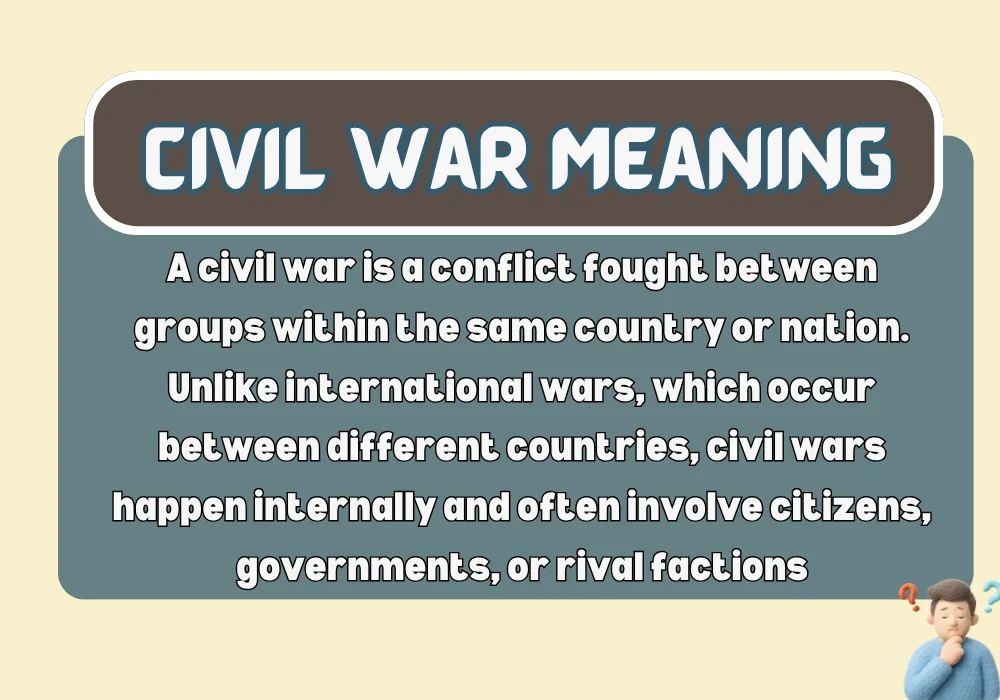
A civil war is a conflict fought between groups within the same country or nation. Unlike international wars, which occur between different countries, civil wars happen internally and often involve citizens, governments, or rival factions.
In simple terms, a civil war is a war within a country.
Origin and Background
The term comes from the Latin phrase bellum civile, meaning war among citizens. Historically, civil wars have occurred when deep disagreements arise over power, governance, ideology, or resources.
Over time, the phrase has become one of the most important concepts in history and political studies, describing some of the most impactful and destructive conflicts.
Key Characteristics of a Civil War
Internal Conflict
A civil war always takes place within the borders of a single country. The fighting groups belong to the same nation but have opposing goals.
Organized Groups
Civil wars usually involve organized groups such as:
- Government forces
- Rebel groups
- Militias
- Political factions
These groups often have clear leadership and objectives.
Control and Power Struggles
Most civil wars are about control, including:
- Political power
- Territory
- Resources
- Ideological influence
Long-Term Impact
Civil wars often cause:
- Economic damage
- Social division
- Loss of life
- Political instability
Civil War Meaning in Simple Language
In everyday terms, a civil war can be understood as:
- A fight within a country
- A conflict between people of the same nation
- A struggle for control or change
It reflects deep division rather than external conflict.
Famous Examples of Civil Wars
Understanding real-world examples helps clarify the civil war meaning.
The American Civil War
One of the most well-known civil wars, fought in the United States from 1861 to 1865. It was mainly about slavery and states’ rights.
Other Examples
- The English Civil War
- The Spanish Civil War
- The Syrian Civil War
Each of these conflicts involved internal divisions over leadership, power, or ideology.
Civil War Compared to Similar Terms
Understanding civil war becomes easier when compared with related concepts.
| Term | Meaning | Key Difference |
|---|---|---|
| Civil War | Conflict within a country | Internal groups involved |
| War | General armed conflict | Can be internal or external |
| Revolution | Major political change | May or may not involve war |
| Rebellion | Resistance against authority | Often smaller scale |
| Conflict | General disagreement | Not always violent |
Civil war specifically refers to large-scale internal armed conflict.
Causes of Civil Wars
Civil wars do not start suddenly. They usually develop due to long-term issues.
Political Causes
- Power struggles
- Weak government systems
- Leadership disputes
Economic Causes
- Unequal distribution of wealth
- Poverty and lack of resources
Social and Cultural Causes
- Ethnic or religious differences
- Social inequality
- Cultural divisions
Ideological Causes
- Differences in beliefs or political systems
- Conflicts between opposing ideologies
Civil War in Modern Usage
Today, the term civil war is also used metaphorically in conversations.
Example Uses
- The team is in a civil war over leadership decisions
- Social media feels like a civil war of opinions
In these cases, civil war describes intense internal disagreement rather than actual fighting.
Effects of Civil Wars
Civil wars often have lasting consequences.
Social Effects
- Division among citizens
- Loss of trust within communities
Economic Effects
- Destruction of infrastructure
- Loss of jobs and stability
Political Effects
- Government changes
- New systems or reforms
Common Mistakes or Misunderstandings
Thinking Civil War Means Any Conflict
Not all conflicts are civil wars. The term is used for large-scale, organized internal fighting.
Confusing Civil War With Revolution
A revolution may not always involve prolonged warfare, while a civil war usually does.
Using the Term Too Casually
Civil war has serious historical meaning and should not be overused in trivial contexts.
Related Words and Concepts
When exploring the civil war meaning, you may also come across:
- Insurgency
- Uprising
- Internal conflict
- Political crisis
- Armed struggle
Each term relates to conflict but differs in scale or context.
FAQs:
What does civil war mean in simple words?
Civil war means a war fought between groups within the same country.
What causes a civil war?
Civil wars are usually caused by political, economic, social, or ideological conflicts.
Is a civil war the same as a revolution?
No, a revolution focuses on change, while a civil war involves large-scale fighting between internal groups.
Can civil war be used in a non-literal way?
Yes, it is sometimes used to describe intense internal disagreements.
Why are civil wars important in history?
Civil wars shape nations, change governments, and have long-lasting social and political effects.
Conclusion:
The civil war meaning represents one of the most serious forms of conflict, involving divisions within a country. It reflects struggles over power, identity, and control that deeply impact societies and history.
By understanding civil war in both its literal and metaphorical sense, you can better interpret historical events and modern discussions where the term appears.

John is the founder and primary content creator of Worlyz. He has a strong passion for explaining word meanings, language concepts, slang terms, and educational topics in a clear and simple way. John focuses on creating well researched, reader friendly content that helps users easily understand complex words and ideas. Through Worlyz, his goal is to make learning meanings and concepts straightforward and accessible for everyone.