If you’ve ever seen >��� in online chats, forums, or social media, you may have paused and wondered what it means. In the fast-paced world of texting and internet slang, symbols like this often appear unexpectedly. Understanding the >��� meaning helps you interpret messages correctly and avoid confusion in conversations online.
This guide breaks it down in simple language, explains its common usage, and provides examples so you can recognize or even use it appropriately.
What Does >��� Mean
Definition
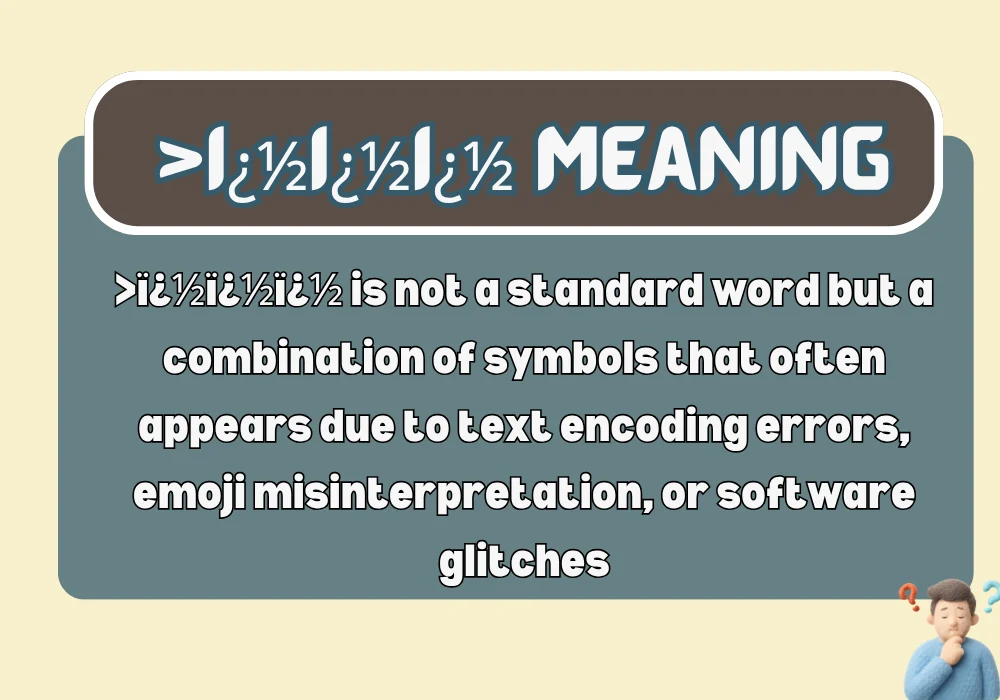
>��� is not a standard word but a combination of symbols that often appears due to text encoding errors, emoji misinterpretation, or software glitches.
In most cases, it represents:
- A failed attempt to display a special character or emoji
- Garbled text caused by mismatched character sets (like UTF-8 vs ASCII)
- Placeholder for unsupported symbols in chat platforms
Essentially, >��� is a visual artifact, not a language-based word.
Origin and Background
The appearance of >��� comes from how computers process text. Modern platforms use Unicode or UTF-8 to support multiple languages and emojis. If a device or app cannot interpret the character properly, it may display the replacement character � (known as the “replacement character” in Unicode).
When combined with other symbols like >, this leads to sequences such as >���.
In short, this is usually a technical display issue, not intentional communication.
How >��� Is Used Online
Technical and Error Context
Most commonly, >��� appears in:
- Messaging apps that do not support certain emojis
- Forums or websites with older encoding settings
- Copy-pasted text from incompatible devices
Example:
- Someone sends a heart emoji ❤️ from a phone, but the recipient’s software cannot display it. It may appear as >��� instead.
Casual and Community Interpretation
In some internet communities, people notice these sequences and jokingly treat them as “mysterious text” or “glitch talk.”
Example:
- Chatting in a forum:
User 1: I just tried sending a gif
User 2: Lol what’s >��� supposed to be
While humorous, this usage is purely informal.
Difference From Emojis or Symbols
Unlike standard emojis or emoticons, >��� does not convey intentional meaning. It usually signals a display problem.
- ✅ Emoji 😊 → intended meaning
- ❌ >��� → unintended artifact
Recognizing this helps avoid confusion in chats or posts.
>��� Meaning in Simple Language
In simple terms:
- It’s a technical glitch caused by unsupported characters
- It appears when software cannot render an intended emoji, accent, or symbol
- It usually has no intentional meaning from the sender
Think of it like a garbled message that your device couldn’t decode properly.
Examples of >��� in Conversations
Messaging Example
Friend 1: Can you check this? >���
Friend 2: Haha that looks broken, I think it’s supposed to be an emoji
Social Media Example
A tweet shows >��� instead of a heart emoji due to old browser support.
Forum Example
��� keeps appearing in posts when copying from different operating systems.
These examples show that >��� rarely carries meaning—it’s mostly a display error.
Why >��� Happens
Common Causes
- Unsupported Emoji or Character – Using an emoji or accented letter that the recipient’s device can’t render.
- Encoding Mismatch – Copy-pasting between UTF-8, ASCII, or other encodings.
- Software Bug – Older apps may not update to the latest Unicode standards.
- Cross-Platform Messaging – Messages sent from iOS may not display correctly on Android or web platforms.
How to Fix or Avoid Seeing >���
- Update Your App or Browser – Ensure software supports modern Unicode characters.
- Use Standard Emojis – Stick to widely supported emojis instead of new or rare ones.
- Check Encoding Settings – Websites and apps should use UTF-8 encoding.
- Re-send the Message – Sometimes simple re-sending fixes the display.
Related Internet Terms
If you are learning about >���, you might also encounter:
- Replacement character (�) – The Unicode symbol shown for unknown characters
- Garbled text – Text that is unreadable due to encoding errors
- Glitch emoji – When an emoji doesn’t render properly
- Encoding error – General term for misinterpreted text
- Mojibake – Japanese term for garbled text caused by incompatible encoding
These terms often appear in forums, tech discussions, or social media troubleshooting.
FAQs:
What does >��� mean in chats?
It usually appears because the app or device cannot display a character or emoji properly.
Is >��� intentional?
No, it is almost always an accidental display error, not something the sender meant to type.
How do I fix >��� in messages?
Update your app, use widely supported emojis, or check encoding settings.
Why does >��� appear on some devices but not others?
Different devices and apps support different versions of Unicode, causing compatibility issues.
Can >��� have a slang meaning?
Not really. While some communities joke about it, it does not have an official slang meaning.
Conclusion:
The >��� meaning is mostly technical rather than linguistic. It appears when your device or app cannot display the intended symbol or emoji, often caused by encoding mismatches, unsupported characters, or software glitches.
By understanding this, you can avoid confusion in online chats, recognize that it is not intentional communication, and even troubleshoot messages when they appear. Although it may look mysterious or funny, >��� is simply a glitch you can usually fix with proper software or settings.

John is the founder and primary content creator of Worlyz. He has a strong passion for explaining word meanings, language concepts, slang terms, and educational topics in a clear and simple way. John focuses on creating well researched, reader friendly content that helps users easily understand complex words and ideas. Through Worlyz, his goal is to make learning meanings and concepts straightforward and accessible for everyone.