The word interdependence may sound academic at first, but it describes something very common in everyday life. From relationships and families to businesses and countries, interdependence plays a major role in how the world functions. Understanding the interdependence meaning helps you better grasp how people, systems, and societies rely on one another to survive and succeed.
Whether you are studying economics, psychology, or simply trying to understand teamwork and cooperation, interdependence is a powerful concept. This guide explains it in clear language with detailed examples, comparisons, and practical applications.
What Does Interdependence Mean
Definition
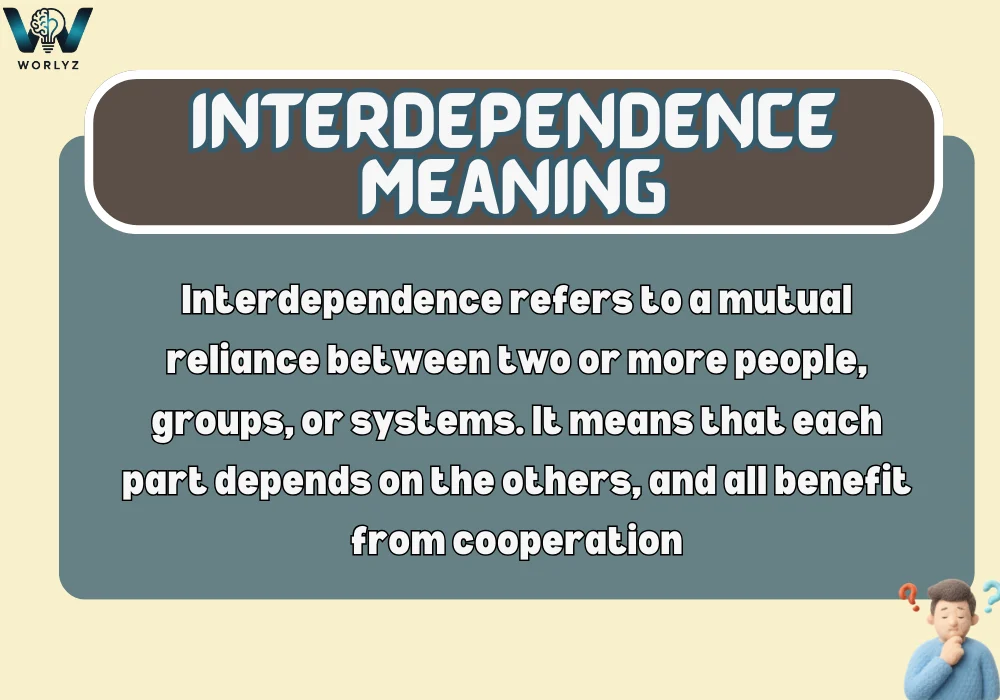
Interdependence refers to a mutual reliance between two or more people, groups, or systems. It means that each part depends on the others, and all benefit from cooperation.
At its core, interdependence means we rely on each other.
Unlike simple dependence, where one side relies on another, interdependence involves shared responsibility and mutual support.
Origin of the Word
Interdependence comes from combining:
- Inter meaning between or among
- Dependence meaning reliance or need
Together, the word literally means mutual reliance between parties. It began appearing frequently in English during discussions about economics, politics, and social systems.
Interdependence in Simple Language
In everyday terms, interdependence means:
- Working together
- Supporting each other
- Sharing responsibility
- Depending on one another equally
For example, in a healthy friendship, both people give and receive support. That is interdependence.
Different Contexts Where Interdependence Is Used
Interdependence in Relationships
In relationships, interdependence describes a balanced connection where both individuals maintain independence while also supporting each other.
Healthy interdependence includes:
- Emotional support
- Mutual respect
- Shared decision-making
- Personal growth
Example:
In a strong marriage, partners are interdependent because they rely on each other while still maintaining individual identities.
Interdependence in Economics
In economics, interdependence refers to how businesses, industries, and countries rely on each other.
Examples:
- Countries trading goods and services
- Companies relying on suppliers
- Workers depending on employers and customers
Modern economies are highly interdependent due to globalization.
Interdependence in Nature
In ecology, interdependence describes how living organisms rely on one another for survival.
Examples:
- Bees pollinating flowers
- Plants producing oxygen for animals
- Predators and prey balancing ecosystems
Nature thrives because of interconnected systems.
Interdependence in Teams and Workplaces
In professional settings, interdependence means teamwork.
Examples:
- Departments cooperating to complete projects
- Employees relying on each other’s skills
- Managers and staff sharing responsibility
When teams are interdependent, productivity improves.
Interdependence Compared to Similar Concepts
Understanding interdependence becomes easier when compared to related terms.
| Word | Meaning | Key Difference |
|---|---|---|
| Interdependence | Mutual reliance | Balanced two-way support |
| Dependence | One-sided reliance | Imbalance |
| Independence | Self-reliance | No reliance on others |
| Codependence | Unhealthy emotional reliance | Loss of individuality |
| Cooperation | Working together | May not require reliance |
Interdependence stands out because it balances independence and reliance.
Examples of Interdependence in Daily Life
Family Example
Parents and children are interdependent because they support and rely on each other in different ways.
Workplace Example
A marketing team depends on designers, and designers depend on marketers to promote their work.
Community Example
Farmers grow food, truck drivers transport it, and stores sell it. Society functions through interdependence.
Personal Growth Example
Friends encourage each other to improve and succeed, creating interdependence.
Benefits of Interdependence
Interdependence offers many advantages:
- Stronger relationships
- Better teamwork
- Increased productivity
- Shared problem-solving
- Emotional support
When individuals or systems recognize their interdependence, cooperation becomes more natural and effective.
Common Misunderstandings About Interdependence
Confusing Interdependence With Dependence
Dependence is one-sided, while interdependence is mutual.
Thinking Interdependence Removes Independence
Interdependence does not eliminate independence. It balances autonomy with cooperation.
Assuming Interdependence Means Weakness
Some believe relying on others shows weakness, but healthy interdependence actually shows maturity and strength.
Interdependence in Modern Society
In today’s connected world, interdependence is stronger than ever.
Examples include:
- Global supply chains
- Digital communication networks
- International trade agreements
- Social media platforms
Technology has increased global interdependence, linking economies and communities across borders.
Related Words and Concepts
When exploring the interdependence meaning, you may also encounter:
- Mutualism
- Cooperation
- Collaboration
- Partnership
- Reciprocity
Each relates to shared effort and mutual benefit.
FAQs:
What does interdependence mean in simple words?
Interdependence means two or more people or systems rely on each other equally.
What is the difference between dependence and interdependence?
Dependence is one-sided reliance, while interdependence involves mutual support.
Is interdependence healthy in relationships?
Yes, healthy relationships are interdependent because both people support and respect each other.
How does interdependence work in economics?
In economics, countries and businesses rely on each other for goods, services, and resources.
Can interdependence exist without independence?
No, healthy interdependence requires individuals or systems to maintain some level of independence.
Conclusion:
The interdependence meaning reflects mutual reliance, shared responsibility, and balanced support. Whether in relationships, business, nature, or global systems, interdependence allows individuals and groups to function more effectively together.
By understanding interdependence, you can better appreciate how cooperation strengthens connections and creates stability in both personal and professional life.

John is the founder and primary content creator of Worlyz. He has a strong passion for explaining word meanings, language concepts, slang terms, and educational topics in a clear and simple way. John focuses on creating well researched, reader friendly content that helps users easily understand complex words and ideas. Through Worlyz, his goal is to make learning meanings and concepts straightforward and accessible for everyone.