The concept of remote work has become a major part of modern life, especially as technology and internet connectivity have transformed how we work. Whether you’ve seen it in job listings, online discussions, or company policies, understanding the remote work meaning is essential for anyone navigating today’s professional world.
Remote work is not just a trend—it represents a shift in how people approach employment, communication, and productivity. This article provides a detailed guide to the meaning of remote work, its benefits, challenges, examples, and related concepts.
What Does Remote Work Mean
Definition
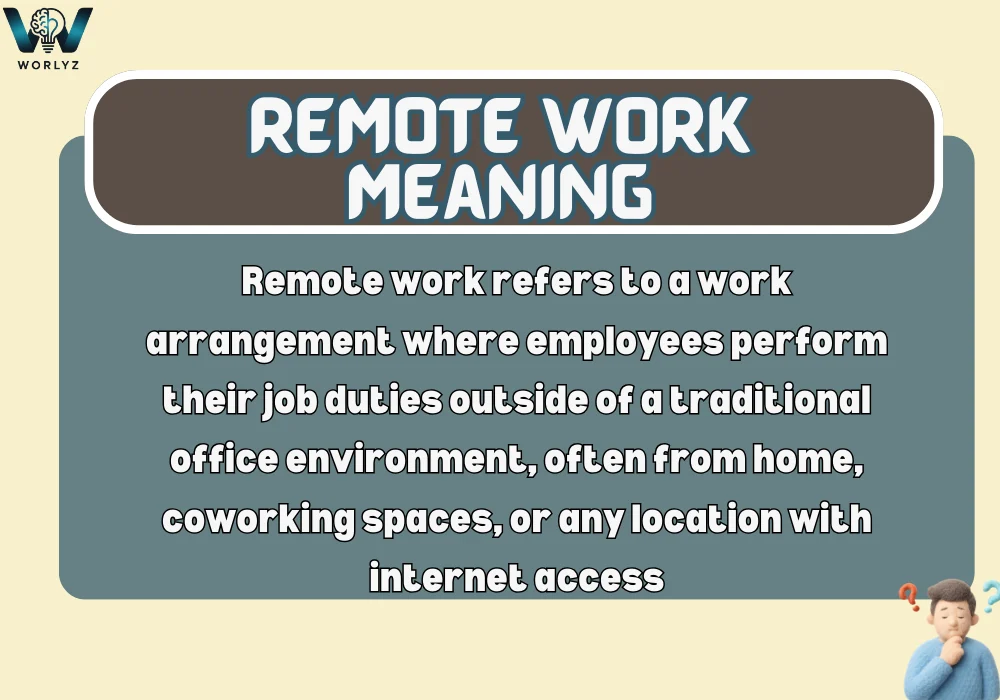
Remote work refers to a work arrangement where employees perform their job duties outside of a traditional office environment, often from home, coworking spaces, or any location with internet access.
Unlike conventional office work, remote work emphasizes flexibility, autonomy, and digital communication.
Origin and Background
Remote work has existed in some form for decades, with telecommuting becoming popular in the late 20th century as computers and the internet improved connectivity.
Key points in its evolution:
- 1970s: Early telecommuting experiments in corporate environments.
- 1990s: Internet expansion allowed more people to work remotely.
- 2020s: COVID-19 accelerated global adoption of remote work.
Today, remote work is recognized as a standard employment model in many industries.
Different Meanings and Types of Remote Work
Remote Work as Full-Time Employment
Full-time remote employees work entirely outside a physical office. Their responsibilities, meetings, and communication are all handled digitally.
Example:
A software developer employed by a U.S. company but working from home in another country.
Remote Work as Part-Time or Hybrid
Some employees work remotely for part of the week and visit the office on other days. This is known as hybrid work.
Example:
A marketing manager works remotely three days a week and attends in-office meetings on Wednesdays.
Freelance and Contract-Based Remote Work
Remote work also includes freelancers or contractors who work on specific projects for clients from anywhere.
Example:
A freelance graphic designer collaborating with clients across multiple time zones.
Digital Nomad Work
Remote work enables digital nomads to travel while working. They rely on laptops, internet connections, and cloud tools to maintain productivity from different countries.
Example:
A content writer working from Bali, Thailand, or Portugal while completing projects for clients abroad.
Remote Work Meaning in Simple Language
In simple terms, remote work means:
- Doing your job without going to a traditional office
- Using digital tools like email, video calls, and project management apps
- Having flexibility in work location and sometimes schedule
- Maintaining responsibility and productivity outside a physical workplace
Examples of Remote Work in Conversations
Professional Example
My company allows employees to do remote work twice a week.
Freelance Example
I do remote work as a freelance translator for multiple international clients.
Casual Example
Remote work has made it easier for me to spend more time with family.
Global Example
Many tech companies now offer full-time remote work, allowing employees to live anywhere in the world.
Benefits of Remote Work
- Flexibility: Employees can adjust work hours to fit personal schedules.
- Cost Savings: Reduced commuting costs and office expenses.
- Work-Life Balance: More time with family or for hobbies.
- Access to Global Talent: Companies can hire skilled employees from anywhere.
- Increased Productivity: Many employees report higher productivity without office distractions.
Challenges of Remote Work
- Isolation: Lack of social interaction can affect mental health.
- Communication Gaps: Misunderstandings may occur without face-to-face meetings.
- Overwork: Flexible schedules can lead to blurred boundaries between work and personal life.
- Technology Dependence: Reliable internet and digital tools are essential.
- Management Difficulties: Supervisors must adapt to managing remote teams effectively.
Remote Work vs. Traditional Office Work
| Feature | Remote Work | Traditional Office Work |
|---|---|---|
| Location | Anywhere with internet | Office or company site |
| Flexibility | High | Usually fixed hours |
| Commute | None | Daily travel required |
| Communication | Digital (calls, email, chat) | In-person meetings |
| Work-Life Balance | Potentially better | Often more structured |
| Cost | Lower for employees | Office costs for company |
This comparison shows why remote work is often favored for flexibility but requires discipline and strong digital communication skills.
Tools and Technology for Remote Work
Remote work relies heavily on technology. Common tools include:
- Video conferencing: Zoom, Microsoft Teams, Google Meet
- Project management: Trello, Asana, Jira
- Collaboration: Slack, Notion, Google Workspace
- File sharing: Dropbox, OneDrive, Google Drive
These tools help teams stay connected, collaborate, and maintain productivity.
Common Mistakes or Misunderstandings
Assuming Remote Work Means No Accountability
Remote workers still have responsibilities and deadlines. Productivity is measured by results, not presence.
Confusing Remote Work With Part-Time Work
Remote work refers to the location, not the number of hours worked.
Believing Remote Work Is Easy
Working remotely requires discipline, self-motivation, and communication skills.
Cultural Impact of Remote Work
Remote work has transformed workplace culture globally:
- Emphasis on results rather than hours worked
- Increased digital literacy among employees
- Rise of coworking spaces and digital nomad communities
- Greater awareness of work-life balance
Companies now prioritize flexibility, trust, and collaboration in ways previously uncommon.
Related Words and Expressions
When learning about remote work, you may also encounter:
- Telecommuting
- Work from home (WFH)
- Hybrid work
- Distributed teams
- Digital nomad
These terms describe variations of remote work or related concepts.
FAQs:
What does remote work mean in simple words?
Remote work means performing your job from outside a traditional office using digital tools.
Is remote work the same as work from home?
Work from home is a type of remote work, but remote work can happen anywhere, not just at home.
Can remote work be full-time?
Yes, remote work can be full-time, part-time, hybrid, or freelance.
What are the main benefits of remote work?
Flexibility, cost savings, work-life balance, and access to global opportunities.
Does remote work require special technology?
Yes, reliable internet, communication apps, and collaboration tools are essential.
Conclusion:
The remote work meaning reflects more than just a job location—it represents a modern approach to employment, communication, and productivity. Remote work allows flexibility, access to global opportunities, and improved work-life balance while requiring discipline, technology, and self-management skills.
Understanding remote work is essential for navigating today’s professional world, whether you are an employee, employer, freelancer, or digital nomad. It has reshaped workplaces, careers, and lifestyles, making location less important than results and collaboration.

John is the founder and primary content creator of Worlyz. He has a strong passion for explaining word meanings, language concepts, slang terms, and educational topics in a clear and simple way. John focuses on creating well researched, reader friendly content that helps users easily understand complex words and ideas. Through Worlyz, his goal is to make learning meanings and concepts straightforward and accessible for everyone.