Have you ever read a message and thought, Wait… what are they trying to say? That’s usually where the word imply comes into play. In everyday conversations, texting, professional emails, and even social media posts, people often imply things instead of saying them directly.
Understanding the imply meaning is important because it helps you read between the lines. Sometimes what’s not said directly is more powerful than what is said clearly. If you misinterpret an implied message, it can lead to confusion, awkwardness, or even conflict.
Let’s break it down in simple, real-life language so you can confidently use and understand the word imply in any situation.
What Does Imply Mean? (Definition and Origin)
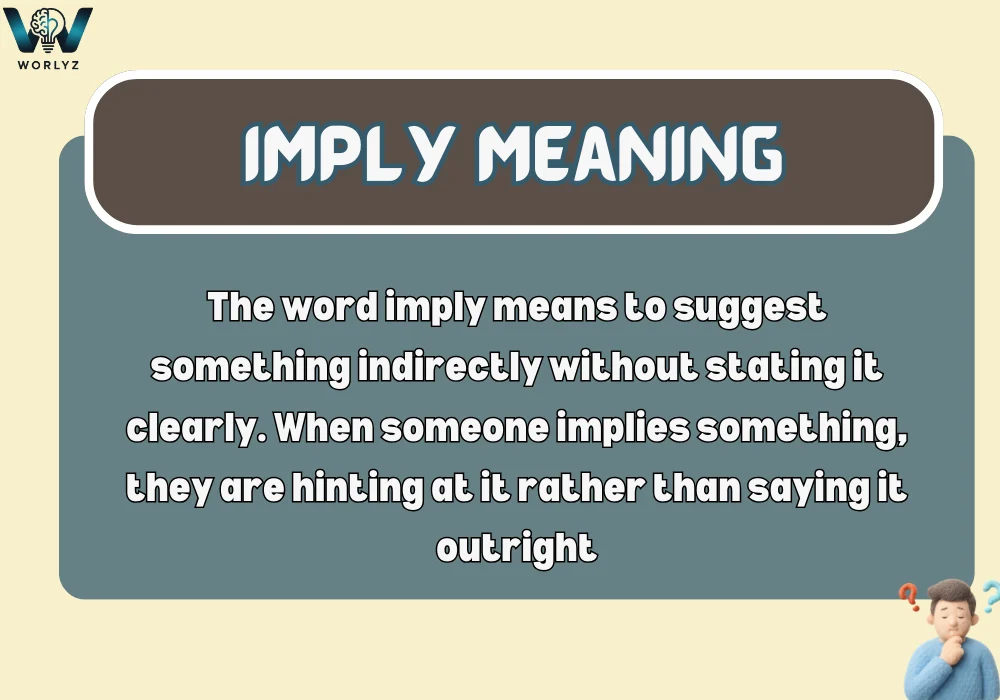
The word imply means to suggest something indirectly without stating it clearly. When someone implies something, they are hinting at it rather than saying it outright.
Simple Definition
To imply means:
- To suggest
- To hint at
- To communicate something indirectly
- To express something without saying it directly
For example:
- She implied that she was unhappy with the decision.
- He implied I was late without actually saying it.
In both cases, the person did not directly say what they meant. Instead, they left clues.
Word Origin
Imply comes from the Latin word implicare, which means to involve or entangle. Over time, it evolved into the modern English meaning of suggesting something indirectly.
Understanding this origin helps explain why implied meanings often feel layered or hidden.
Imply vs Infer: What’s the Difference?
One of the most common mistakes people make is confusing imply with infer. These two words are closely connected but have different roles.
Here’s an easy way to remember:
- The speaker implies.
- The listener infers.
Comparison Table: Imply vs Infer
| Word | Who Does It? | Meaning | Example |
|---|---|---|---|
| Imply | Speaker | Suggest indirectly | She implied I should leave early. |
| Infer | Listener | Understand indirectly | I inferred she wanted me to leave. |
Think of it like this:
- If you drop hints, you imply.
- If you pick up hints, you infer.
This small difference can completely change how you use the word correctly.
How to Use Imply in Sentences
Using imply correctly is easier than it sounds. It usually appears when someone hints at something without being direct.
Basic Sentence Structure
Subject + imply + that + idea
Examples:
- He implied that I wasn’t prepared.
- The email implied there would be changes soon.
- Her tone implied she was upset.
Notice that imply is often followed by that, although that can sometimes be omitted in casual speech.
Example:
- She implied I should apologize.
Everyday Situations
Here’s how imply shows up in real life:
- Workplace
- My boss implied that my report needed improvement.
- Relationships
- She implied she wanted more attention.
- School
- The teacher implied we should study chapter five carefully.
In all these cases, the message is not directly stated but clearly suggested.
Examples of Imply in Conversations
Understanding imply becomes much easier when you see it in natural conversations.
Texting Example
- Friend 1: Are you going out tonight?
- Friend 2: I have a big meeting tomorrow morning.
Friend 2 is implying they won’t go out. They didn’t directly say no, but the meaning is clear.
Social Media Example
Post: Some people really need to learn basic manners.
This could imply frustration with someone specific, even if no name is mentioned.
Office Example
Manager: We expect everyone to arrive on time.
Employee who came late yesterday may feel this implies criticism.
In modern communication, especially online, people imply things constantly. Subtle messages are everywhere.
When People Use Imply Instead of Saying Things Directly
There are many reasons why people imply rather than speak directly:
- To avoid hurting someone’s feelings
- To stay polite
- To avoid confrontation
- To sound professional
- To maintain subtlety
For example, instead of saying:
You did a bad job.
Someone might say:
This could have been handled differently.
That sentence implies dissatisfaction without being harsh.
In professional communication, implying can sound more respectful and less aggressive.
Different Contexts Where Imply Is Common
The word imply is widely used in different fields and settings.
Academic Writing
In essays and research papers, imply is often used to suggest conclusions.
Example:
The results imply a strong connection between sleep and productivity.
Literature
Authors imply themes rather than state them directly. Readers infer deeper meanings from symbols and character actions.
Legal Context
Lawyers often argue that evidence implies guilt or innocence without direct proof.
Everyday Conversations
Most daily conversations are full of implied meanings. Tone of voice, facial expressions, and word choice all play a role.
Common Mistakes or Misunderstandings
Even though imply is a common word, people still misuse it.
Mistake 1: Using Imply Instead of Infer
Wrong:
I implied from his words that he was angry.
Correct:
I inferred from his words that he was angry.
Remember:
Speaker implies.
Listener infers.
Mistake 2: Assuming Too Much
Sometimes people think something was implied when it wasn’t. This can lead to misunderstandings.
For example:
If someone says, That’s interesting, you might infer sarcasm even if none was implied.
This shows how communication depends on both sides.
Related Words and Similar Meanings
If you’re looking to expand your vocabulary, here are some words similar to imply:
- Suggest
- Hint
- Indicate
- Signal
- Insinuate
- Allude
Quick Comparison Table
| Word | Strength of Meaning | Tone |
|---|---|---|
| Suggest | Mild | Neutral |
| Hint | Very subtle | Casual |
| Imply | Indirect but clear | Neutral |
| Insinuate | Often negative | Critical |
| Allude | Reference indirectly | Formal |
For example:
- He insinuated I was lying. This sounds more negative.
- He implied I was mistaken. This sounds more neutral.
Choosing the right word changes the tone of your message.
Why Understanding Imply Matters in Modern Communication
In today’s world of texting, emails, and social media, implied meanings are everywhere.
Short messages often leave room for interpretation.
Example:
Fine.
Depending on context, that could imply:
- I’m okay.
- I’m annoyed.
- I don’t want to argue.
- I’m done talking.
Understanding implied meaning helps you avoid overreacting or misreading situations.
It also helps you communicate more effectively. Sometimes being direct is better. Other times, subtle implication works best.
Frequently Asked Questions:
What does imply mean in simple words?
Imply means to suggest something without saying it directly. It is when you hint at an idea instead of clearly stating it.
What is the difference between imply and infer?
Imply is what the speaker does by hinting at something. Infer is what the listener does by understanding the hidden meaning.
Can imply be used in formal writing?
Yes, imply is commonly used in academic, professional, and legal writing to suggest conclusions indirectly.
Is imply always negative?
No, imply can be neutral or positive. It simply means suggesting something indirectly. The tone depends on the context.
How do I use imply in a sentence?
You can use it like this:
She implied that changes were coming.
He implied I should leave early.
Conclusion:
Understanding the true imply meaning helps you become a better communicator and a smarter listener. When someone implies something, they are offering a subtle clue instead of a direct statement. Recognizing these clues prevents misunderstandings and improves your social, academic, and professional communication.
In everyday life, implied meanings are everywhere. From workplace feedback to casual texts, people often rely on hints instead of direct statements. Knowing how to both imply and interpret implied messages gives you an advantage in conversations.
Now it’s your turn. Have you ever misunderstood something someone implied? Share your favorite example of implied communication in the comments!

John is the founder and primary content creator of Worlyz. He has a strong passion for explaining word meanings, language concepts, slang terms, and educational topics in a clear and simple way. John focuses on creating well researched, reader friendly content that helps users easily understand complex words and ideas. Through Worlyz, his goal is to make learning meanings and concepts straightforward and accessible for everyone.