The word abstraction is often used in education, philosophy, art, computer science, and everyday thinking. Even though it sounds technical, its basic idea is actually simple once you break it down. Understanding the abstraction meaning helps you see how people simplify complex ideas and focus only on what really matters.
From modern technology to creative art and even daily decision-making, abstraction is everywhere. It helps humans understand complicated systems by removing unnecessary details.
What Does Abstraction Mean
Definition
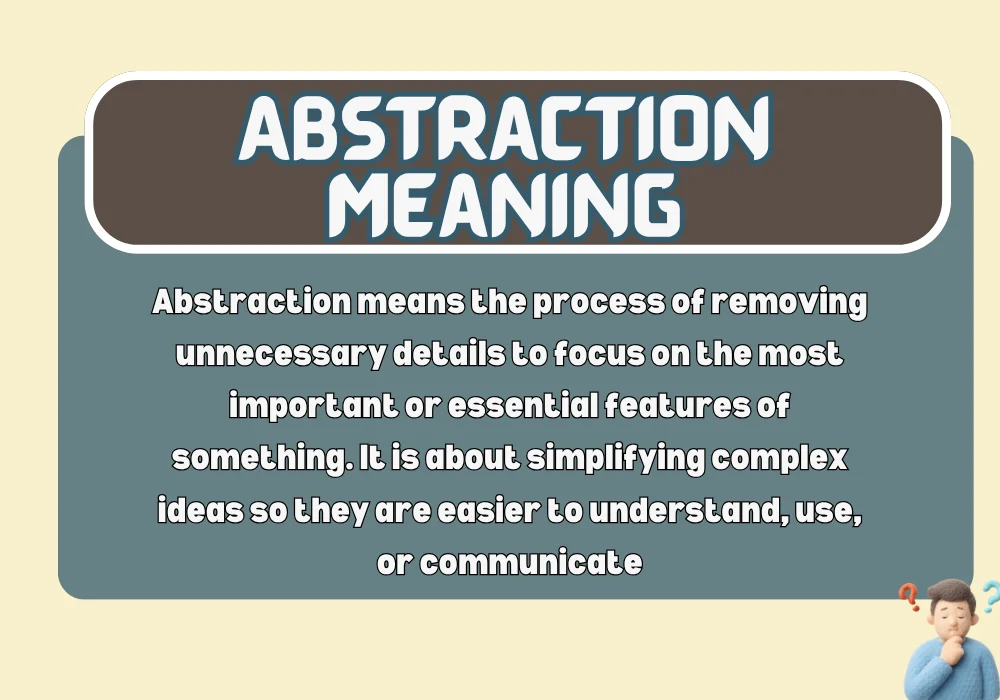
Abstraction means the process of removing unnecessary details to focus on the most important or essential features of something. It is about simplifying complex ideas so they are easier to understand, use, or communicate.
In simple terms, abstraction is:
- Ignoring less important details
- Focusing only on key information
- Creating a simplified version of reality
Origin and Background
The word abstraction comes from the Latin word abstrahere, which means to draw away or separate. Over time, it became widely used in philosophy and science to describe how humans think and understand complex concepts.
Today, abstraction is used in many fields like:
- Programming
- Art
- Mathematics
- Psychology
- Communication
Different Meanings of Abstraction Based on Context
Abstraction in Everyday Thinking
In daily life, abstraction happens when we simplify things in our mind.
Example:
When you think of a car, you don’t think about every single bolt—you just imagine the idea of a vehicle.
This mental simplification is abstraction.
Abstraction in Art
In art, abstraction means creating work that does not represent reality exactly but instead focuses on shapes, colors, and ideas.
Examples include:
- Abstract paintings
- Modern art styles
- Symbolic designs
Here, the goal is expression rather than realistic detail.
Abstraction in Computer Science
In programming, abstraction means hiding complex code details and showing only necessary functions to the user.
Example:
When you use a mobile app, you don’t see how the code works—you only see buttons and features.
That is abstraction in action.
Abstraction in Philosophy
In philosophy, abstraction refers to thinking about ideas without focusing on physical details.
Example:
Thinking about “justice” without linking it to a specific case is abstraction.
Abstraction Meaning in Simple Language
In everyday terms, abstraction means:
- Making something simpler
- Removing unnecessary details
- Focusing on the main idea
- Understanding the “big picture”
It helps people handle complex information without feeling overwhelmed.
Examples of Abstraction in Real Life
Daily Life Example
When you say “school,” you are not thinking about classrooms, teachers, books, and buildings individually—you think of the overall concept. That is abstraction.
Technology Example
A smartphone app hides complex coding so users can simply tap icons. This is abstraction in design.
Art Example
An abstract painting may not show real objects but still expresses emotions or ideas.
Communication Example
Instead of describing every detail of a meeting, you say “it went well.” That is abstract summarization.
Abstraction Compared to Similar Concepts
Understanding abstraction becomes easier when compared with related ideas.
| Term | Meaning | Key Difference |
|---|---|---|
| Abstraction | Simplifying complex information | Focuses on essential ideas |
| Detail | Full information | Includes everything |
| Summary | Short version of content | Still structured information |
| Concept | General idea | More theoretical |
| Representation | Visual or symbolic form | May still include details |
Abstraction is about removing detail, not just shortening content.
Why Abstraction Is Important
Abstraction plays a major role in how humans think and solve problems.
It helps with:
- Understanding complex systems
- Making decisions faster
- Improving communication
- Reducing mental overload
- Designing better technology
Without abstraction, everything would feel too complicated to process.
Common Mistakes or Misunderstandings
Thinking Abstraction Means Ignoring Everything
Abstraction does not mean ignoring information completely. It means focusing on what matters most.
Confusing Abstraction With Simplicity Only
Simplicity is about being easy, while abstraction is about selective focus.
Assuming It Only Belongs to Science
Abstraction is used in everyday thinking, not just technical fields.
Abstraction in Modern Life
Today, abstraction is used in:
- Mobile apps and user interfaces
- Artificial intelligence systems
- Digital design
- Business strategies
- Education models
For example, when you use social media, you interact with a simple interface while complex systems work behind the scenes. That is abstraction in technology.
Related Words and Concepts
When learning abstraction meaning, you may also encounter:
- Simplification
- Conceptualization
- Generalization
- Representation
- Modeling
Each term connects to abstraction but focuses on slightly different aspects.
FAQs:
What does abstraction mean in simple words?
Abstraction means removing unnecessary details and focusing on the main idea or important features.
Where is abstraction used in real life?
Abstraction is used in technology, education, art, communication, and everyday thinking.
What is abstraction in computer science?
In programming, abstraction hides complex code and shows only necessary features to the user.
Is abstraction the same as simplification?
Not exactly. Simplification makes things easier, while abstraction focuses on essential details and removes unnecessary ones.
Why is abstraction important?
Abstraction helps people understand complex ideas, make decisions faster, and communicate more clearly.
Conclusion:
The abstraction meaning revolves around simplifying complex ideas by focusing only on what is essential. Whether in technology, art, philosophy, or daily thinking, abstraction helps people understand the world more easily and efficiently.
By learning how abstraction works, you can improve your thinking, communication, and problem-solving skills in many areas of life.

Alex is the owner and founder of Worlyz. He is passionate about explaining word meanings, language concepts, slang terms, and educational topics in a clear and simple manner. Alex focuses on creating high quality, well researched, and user focused content that helps readers understand complex words easily. Through Worlyz, his goal is to make learning language meanings and concepts accessible and reliable for everyone.