The word timeline is commonly used in education, history, business, social media, and everyday conversations. Even though it sounds straightforward, its meaning can change depending on context. Understanding the timeline meaning helps you organize events, explain processes clearly, and communicate ideas in a structured way.
From historical events to project planning and even social media feeds, timeline is a powerful concept that helps people understand when things happen and in what order.
What Does Timeline Mean
Definition
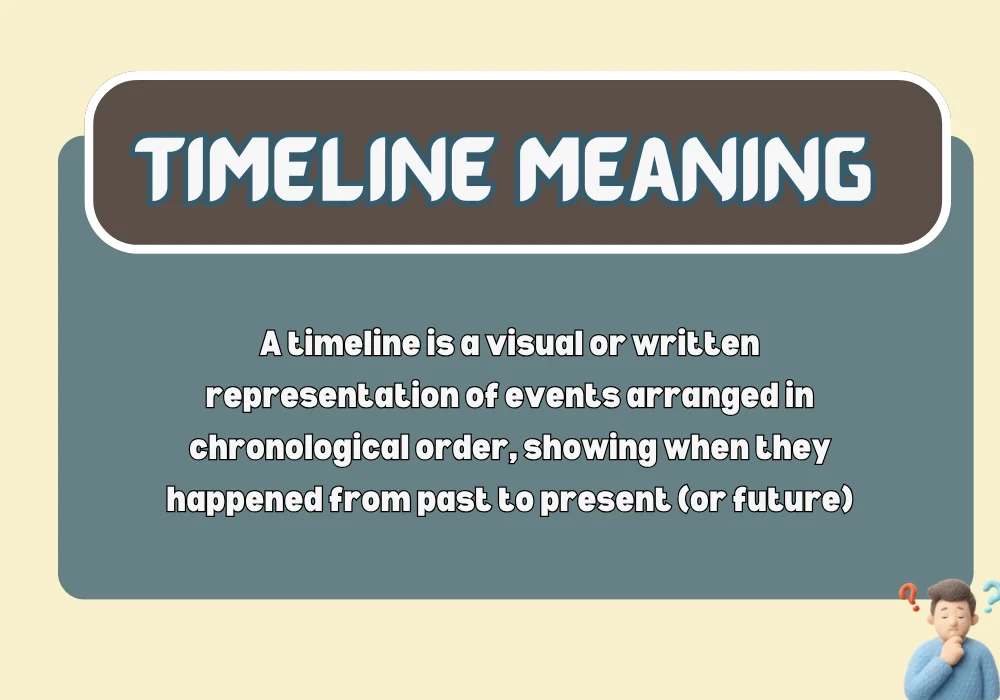
A timeline is a visual or written representation of events arranged in chronological order, showing when they happened from past to present (or future).
In simple words, a timeline helps you see what happened first, next, and last.
Origin and Background
The word timeline is formed by combining:
- Time meaning sequence or duration
- Line meaning a straight path or order
Originally, timelines were used in history to display important events. Over time, the concept expanded into:
- Project management
- Personal planning
- Social media platforms
Today, timeline is both a visual tool and a general concept.
Different Meanings of Timeline Based on Context
Timeline in History and Education
In history, a timeline shows events in the order they occurred.
Examples:
- A timeline of world wars
- A timeline of a country’s independence
- A timeline of a person’s life
This helps students and readers understand how events are connected over time.
Timeline in Projects and Work
In business and professional settings, a timeline is used to plan tasks and deadlines.
Examples:
- Project timeline
- Product launch timeline
- Assignment timeline
A timeline in this context helps teams stay organized and meet deadlines.
Timeline in Social Media
On social media platforms, timeline refers to a feed of posts arranged by time.
Examples:
- Viewing your timeline on Facebook
- Scrolling through your timeline on X or Instagram
Here, timeline shows your activity or posts in chronological order.
Timeline in Personal Life
People also use timelines in everyday life to plan or reflect.
Examples:
- Career timeline
- Relationship timeline
- Daily routine timeline
This helps in organizing goals and understanding personal progress.
Timeline Meaning in Simple Language
In everyday language, timeline means:
- A list of events in order
- A schedule of tasks and deadlines
- A sequence showing how things happen over time
It is all about structure, order, and clarity.
Examples of Timeline in Conversations
Everyday Conversation Example
Can you create a timeline for your study plan?
Work Related Example
We need a clear timeline to finish this project on time.
Social Media Example
I saw that post on my timeline yesterday.
Personal Context Example
Her career timeline shows steady growth over the years.
These examples show how timeline fits into different areas of life.
Timeline Compared to Similar Words
Understanding timeline becomes easier when compared to related terms.
| Word | Meaning | Key Difference |
|---|---|---|
| Timeline | Ordered sequence of events | Focus on time and order |
| Schedule | Planned timing of tasks | More about future planning |
| Chronology | Study of events in time | More formal and academic |
| Plan | General outline of actions | Not always time-based |
| Calendar | System of dates | Focus on days and months |
Timeline specifically emphasizes order and sequence over time.
Types of Timelines
Timelines can take different forms depending on their purpose.
Horizontal Timeline
Events are arranged from left to right. This is the most common format.
Vertical Timeline
Events are listed from top to bottom. Often used in resumes or reports.
Visual Timeline
Includes images, icons, or graphics to make information easier to understand.
Digital Timeline
Used in apps, websites, or social media feeds.
Importance of Timelines
Timelines are important because they:
- Make complex information easier to understand
- Show cause and effect relationships
- Help with planning and organization
- Improve clarity in communication
Without timelines, it becomes harder to track progress or understand sequences.
Common Mistakes or Misunderstandings
Thinking Timeline Is Only for History
Timelines are used in many fields like business, education, and daily life.
Confusing Timeline With Schedule
A timeline shows order of events, while a schedule focuses more on exact timing.
Ignoring Chronological Order
A timeline must follow correct order, otherwise it loses meaning.
Timeline in Modern Usage
Today, timeline is widely used in:
- Project management tools
- Educational materials
- Social media platforms
- Personal productivity systems
People rely on timelines to stay organized and track progress efficiently.
Related Words and Concepts
When learning the timeline meaning, you may also come across:
- Chronology
- Sequence
- Schedule
- Progress
- Milestones
These words are closely connected but used in slightly different ways.
FAQs:
What does timeline mean in simple words?
Timeline means a list or display of events arranged in the order they happened.
What is a timeline used for?
A timeline is used to organize events, plan tasks, and show progress over time.
Is timeline the same as schedule?
No, a timeline shows the sequence of events, while a schedule focuses on specific timings.
Can timelines be used in daily life?
Yes, people use timelines for planning goals, tracking progress, and organizing routines.
What is a social media timeline?
A social media timeline is a feed of posts displayed in chronological order.
Conclusion:
The timeline meaning is centered around order, structure, and clarity. It helps organize events, track progress, and present information in a way that is easy to understand. Whether used in history, business, or daily life, timelines make complex sequences simple and clear.
By understanding how timelines work, you can plan better, communicate more effectively, and make sense of events in a logical way.

Alex is the owner and founder of Worlyz. He is passionate about explaining word meanings, language concepts, slang terms, and educational topics in a clear and simple manner. Alex focuses on creating high quality, well researched, and user focused content that helps readers understand complex words easily. Through Worlyz, his goal is to make learning language meanings and concepts accessible and reliable for everyone.