The prefix trans is widely used in English and appears in many common words across science, everyday language, education, and even modern discussions online. You may have seen it in words like transport, transform, or translate and wondered what it actually means. Understanding the trans prefix meaning helps you break down complex words and improve your vocabulary naturally.
Prefixes like trans are powerful because they give clues about the meaning of a word before you even look it up. Once you understand how this prefix works, you can quickly recognize patterns in dozens of English words.
What Does the Prefix Trans Mean
Definition
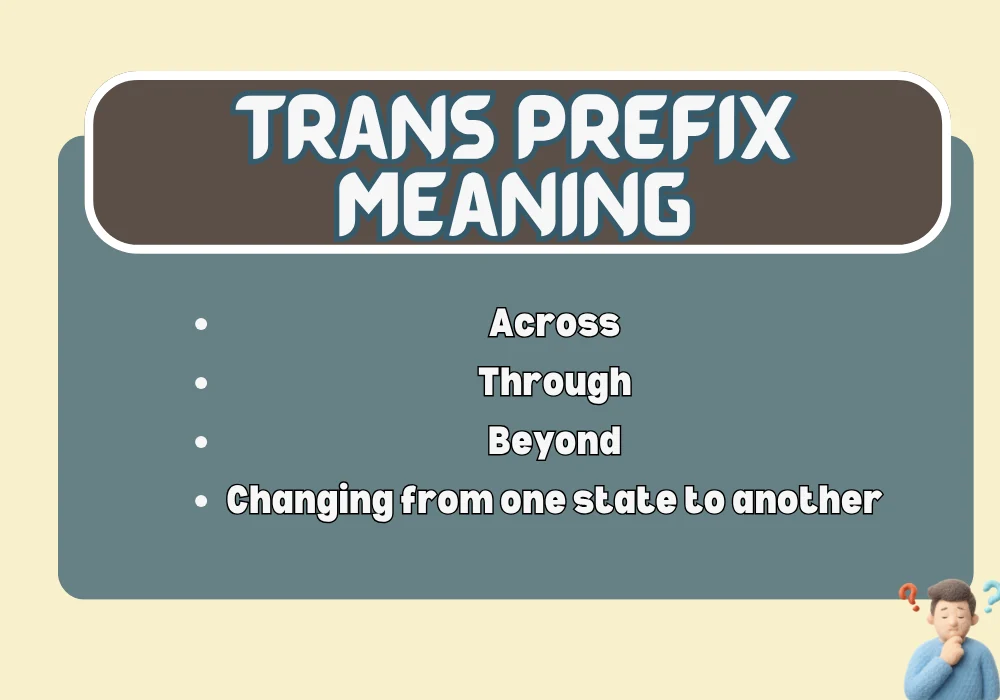
The prefix trans means:
- Across
- Through
- Beyond
- Changing from one state to another
It is added to the beginning of words to modify their meaning.
In simple terms, trans often describes movement, change, or crossing from one place or condition to another.
Origin of the Prefix
The prefix trans comes from Latin, where it meant across or beyond. It was used in ancient Roman language to describe movement from one side to another.
As English developed, trans became part of many words, especially in:
- Science
- Geography
- Communication
- Technology
Its original meaning has remained mostly consistent over time.
How the Trans Prefix Changes Word Meaning
The prefix trans adds a sense of movement or change to the base word.
For example:
- Port means carry → Transport means carry across
- Form means shape → Transform means change shape
- Late means carry or bring → Translate means carry meaning across languages
By adding trans, the word gains a new meaning related to transition or movement.
Common Words Using the Trans Prefix
Everyday Words
Here are some common examples of words that use the trans prefix:
- Transport meaning to carry across
- Transfer meaning to move from one place to another
- Translate meaning to change language
- Transmit meaning to send across
- Transform meaning to change completely
These words are used in daily conversation and writing.
Academic and Technical Words
The prefix trans is also widely used in more advanced or technical terms:
- Transcontinental meaning across a continent
- Transatlantic meaning across the Atlantic Ocean
- Transfusion meaning transferring blood
- Transistor meaning a device that transfers electrical signals
Understanding the prefix helps simplify these complex terms.
Trans Prefix Meaning in Simple Language
In everyday language, trans usually means:
- Moving from one place to another
- Passing through something
- Changing into something different
Once you recognize this pattern, you can guess the meaning of many unfamiliar words.
Examples of Trans Words in Sentences
Everyday Example
The company will transport goods across the country.
Communication Example
She can translate Spanish into English.
Change Based Example
The city has transformed over the years.
Technical Example
The signal is transmitted through the device.
These examples show how trans works in different contexts.
Trans Compared to Similar Prefixes
Understanding trans becomes easier when compared to other prefixes with similar meanings.
| Prefix | Meaning | Key Difference |
|---|---|---|
| Trans | Across or beyond | Movement or change |
| Inter | Between | Connection between things |
| Sub | Under | Position below |
| Super | Above or beyond | Higher level or excess |
| Re | Again | Repetition |
Trans specifically focuses on crossing, movement, or transformation.
Different Contexts Where Trans Is Used
Movement and Direction
Words like transport and transfer show physical movement from one place to another.
Communication and Language
Words like translate and transmit involve passing information across.
Change and Transformation
Words like transform describe change from one state to another.
Science and Geography
Words like transcontinental describe crossing large areas.
Common Mistakes or Misunderstandings
Assuming Trans Always Means Across
While across is the main meaning, trans can also mean change or transformation depending on the word.
Confusing Trans With Other Prefixes
People sometimes mix trans with inter or sub, but each has a different meaning.
Ignoring the Root Word
The full meaning comes from both the prefix and the base word, not the prefix alone.
Why Learning Prefixes Like Trans Is Important
Understanding prefixes like trans helps you:
- Expand your vocabulary faster
- Understand unfamiliar words easily
- Improve reading and writing skills
- Recognize patterns in language
Instead of memorizing each word, you learn how words are built.
Related Prefixes and Word Parts
When studying the trans prefix meaning, you may also encounter:
- Pre meaning before
- Post meaning after
- Anti meaning against
- Auto meaning self
- Bio meaning life
These prefixes help build a stronger understanding of English vocabulary.
FAQs:
What does the prefix trans mean in simple words?
Trans means across, through, or changing from one state to another.
Can trans mean change?
Yes, in words like transform, trans shows a change from one form to another.
Is trans used in everyday English?
Yes, many common words like transport and transfer use the trans prefix.
How can I understand words with trans easily?
Break the word into parts and combine the meaning of trans with the root word.
Is trans a Latin prefix?
Yes, trans comes from Latin and has kept its meaning over time.
Conclusion:
The trans prefix meaning centers around movement, change, and crossing from one place or state to another. It is one of the most useful prefixes in English and appears in a wide range of everyday and technical words.
By understanding how trans works, you can quickly decode new words, improve your vocabulary, and communicate more effectively in both casual and formal situations.

John is the founder and primary content creator of Worlyz. He has a strong passion for explaining word meanings, language concepts, slang terms, and educational topics in a clear and simple way. John focuses on creating well researched, reader friendly content that helps users easily understand complex words and ideas. Through Worlyz, his goal is to make learning meanings and concepts straightforward and accessible for everyone.