The word brainstorming is widely used in workplaces, classrooms, creative fields, and even casual conversations. Whether you are planning a project, solving a problem, or coming up with new ideas, you have likely heard someone say let’s do some brainstorming. Understanding the brainstorming meaning helps you use the term correctly and make the most out of this powerful thinking technique.
Brainstorming is not just about random ideas. It is a structured yet flexible way to generate creative solutions without immediate judgment. In today’s fast-paced world, brainstorming plays a key role in innovation, teamwork, and problem-solving.
What Does Brainstorming Mean
Definition
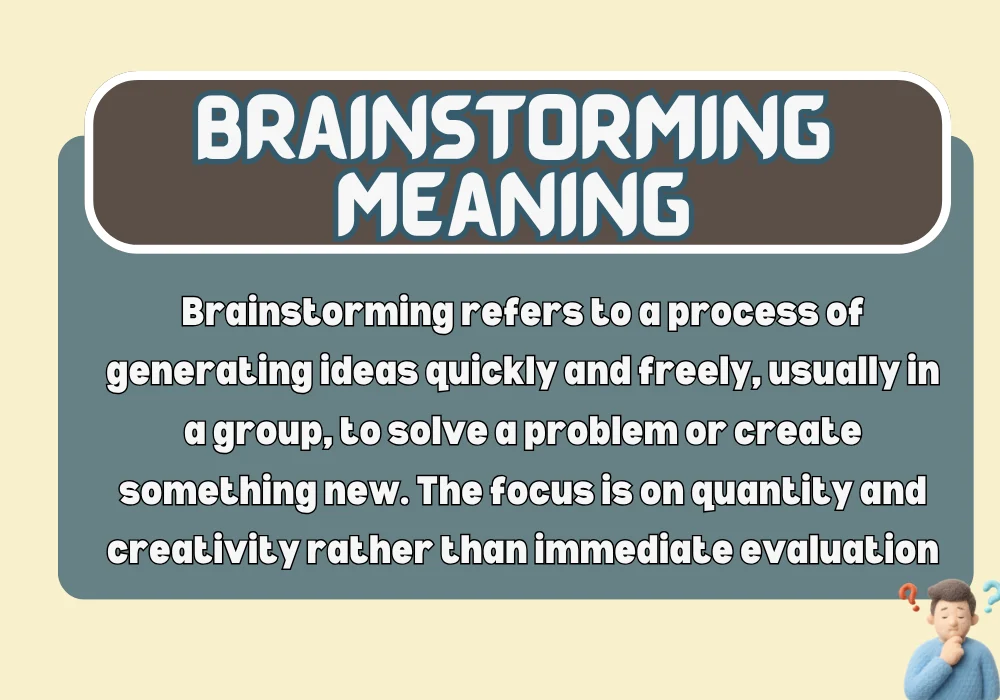
Brainstorming refers to a process of generating ideas quickly and freely, usually in a group, to solve a problem or create something new. The focus is on quantity and creativity rather than immediate evaluation.
In simple terms, brainstorming means thinking of as many ideas as possible without overthinking or judging them.
Origin of the Word
The term brainstorming was popularized in the 1940s by advertising executive Alex Osborn. He introduced it as a creative problem-solving method where people could freely share ideas in a group setting.
The idea behind the word is similar to a storm in the brain, where thoughts come rapidly and energetically.
How Brainstorming Works
Basic Principle
Brainstorming works on one key rule:
- Do not judge ideas during the idea generation phase
This encourages people to think freely and share even unusual or creative ideas.
Common Steps in Brainstorming
A typical brainstorming session includes:
- Define the problem or goal clearly
- Gather a group or prepare individually
- Generate as many ideas as possible
- Record all ideas without criticism
- Review and refine ideas later
This process helps unlock creativity and encourages participation.
Types of Brainstorming
Individual Brainstorming
This involves thinking alone and writing down ideas. It works well when:
- You prefer quiet thinking
- You want to focus deeply
- You need personal creativity
Group Brainstorming
This involves multiple people sharing ideas together. It is useful for:
- Team projects
- Diverse perspectives
- Faster idea generation
Mind Mapping
A visual form of brainstorming where ideas are connected around a central topic.
Example:
Start with one main idea and branch out into related thoughts.
Reverse Brainstorming
Instead of asking how to solve a problem, you ask how to create it. Then you reverse those ideas into solutions.
Brainstorming Meaning in Simple Language
In everyday language, brainstorming means:
- Thinking of ideas quickly
- Sharing thoughts without fear
- Being creative without limits
It is about letting your mind explore freely.
Examples of Brainstorming in Conversations
Work Example
Let’s brainstorm ideas for the new marketing campaign.
School Example
We need to brainstorm topics for our project.
Casual Example
We were brainstorming ways to plan the trip.
These examples show how commonly the word is used in daily life.
Brainstorming Compared to Similar Concepts
| Word | Meaning | Key Difference |
|---|---|---|
| Brainstorming | Generating many ideas quickly | Focus on creativity |
| Planning | Organizing steps | More structured |
| Problem solving | Finding solutions | Includes evaluation |
| Discussion | Talking about ideas | May include judgment |
| Ideation | Creating ideas | More formal term |
Brainstorming focuses on idea generation without filtering.
Benefits of Brainstorming
Brainstorming offers several advantages:
- Encourages creativity
- Promotes teamwork
- Generates multiple solutions
- Builds confidence in sharing ideas
- Helps solve complex problems
It is widely used because it unlocks new ways of thinking.
Common Mistakes in Brainstorming
Judging Ideas Too Early
Criticizing ideas during brainstorming can stop creativity.
Limiting Ideas
Thinking only of safe or realistic ideas reduces innovation.
Not Recording Ideas
Forgetting to write ideas can lead to lost opportunities.
Dominating the Conversation
In group brainstorming, one person should not control all ideas.
Tips for Effective Brainstorming
- Keep an open mind
- Encourage all ideas
- Build on others’ suggestions
- Stay focused on the topic
- Review ideas after the session
These tips improve the quality of brainstorming sessions.
Brainstorming in Modern Use
Today, brainstorming is used in:
- Business meetings
- Startup planning
- Content creation
- Education
- Social media strategies
Even individuals use brainstorming for personal goals, content ideas, or problem-solving.
Related Words and Concepts
When learning the brainstorming meaning, you may also come across:
- Idea generation
- Creative thinking
- Mind mapping
- Innovation
- Collaboration
These concepts are closely connected to brainstorming.
FAQs:
What does brainstorming mean in simple words?
Brainstorming means thinking of many ideas quickly without judging them.
Is brainstorming only done in groups?
No, brainstorming can be done individually or in groups.
Why is brainstorming important?
Brainstorming helps generate creative ideas and find solutions to problems.
What is the main rule of brainstorming?
The main rule is not to judge or criticize ideas during the idea generation stage.
Can brainstorming be used in daily life?
Yes, brainstorming can be used for planning, decision-making, and solving everyday problems.
Conclusion:
The brainstorming meaning goes beyond simply thinking of ideas. It is a powerful method that encourages creativity, collaboration, and open thinking. Whether used in business, education, or personal life, brainstorming helps generate fresh ideas and solve problems effectively.
By understanding how brainstorming works and applying it correctly, you can improve your creativity and approach challenges with confidence.

John is the founder and primary content creator of Worlyz. He has a strong passion for explaining word meanings, language concepts, slang terms, and educational topics in a clear and simple way. John focuses on creating well researched, reader friendly content that helps users easily understand complex words and ideas. Through Worlyz, his goal is to make learning meanings and concepts straightforward and accessible for everyone.