The word entendre may look unfamiliar at first, but it appears often in literature, conversations about language, music lyrics, and online discussions. Most people encounter it through the phrase double entendre, which is commonly used in comedy, movies, songs, and social media. Understanding the entendre meaning helps you recognize hidden meanings, wordplay, and expressions used in modern communication.
Although entendre comes from French, it has become part of English vocabulary, especially in creative writing and entertainment. This detailed guide explains the meaning, usage, examples, comparisons, and common misunderstandings in a simple and easy-to-follow way.
What Does Entendre Mean
Definition
Entendre is a French word that means to hear or to understand. In English usage, it is mostly connected to the phrase double entendre, which refers to a word or phrase with two meanings.
Usually:
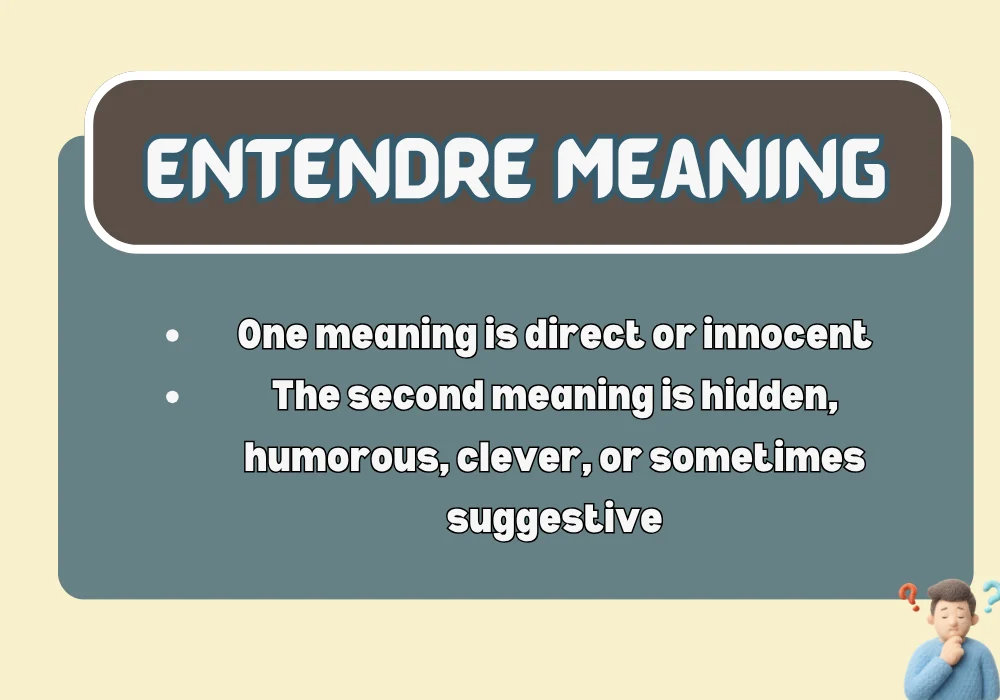
- One meaning is direct or innocent
- The second meaning is hidden, humorous, clever, or sometimes suggestive
At its core, entendre is about layered meaning and interpretation.
Origin of the Word
The word comes from the French verb entendre, meaning:
- To hear
- To understand
- To interpret
English adopted the term mainly through literature and comedy. Over time, it became strongly associated with clever wordplay and hidden meanings.
What Is a Double Entendre
Simple Explanation
A double entendre is a phrase that can be understood in two different ways.
One meaning is usually obvious, while the second meaning may be:
- Funny
- Sarcastic
- Romantic
- Suggestive
- Clever
Example:
She said the joke went over his head.
This could mean:
- He did not understand the joke
- The statement has a hidden humorous meaning depending on context
Why Double Entendres Are Popular
Double entendres are popular because they:
- Add humor
- Make conversations more clever
- Create hidden meanings
- Keep language entertaining and creative
They are especially common in:
- Movies
- Stand-up comedy
- Song lyrics
- Internet memes
- Social media captions
Entendre Meaning in Simple Language
In simple terms, entendre relates to:
- Understanding hidden meanings
- Hearing something in more than one way
- Clever or layered language
When people mention entendre, they usually mean a phrase with a double meaning.
Examples of Entendre in Conversations
Casual Conversation Example
That joke was a double entendre I almost missed.
Social Media Example
The caption sounds innocent, but it is clearly a double entendre.
Music Example
Many pop songs use double entendre lyrics to sound clever or playful.
Comedy Example
Stand-up comedians often rely on entendre to make jokes more interesting.
These examples show how entendre appears naturally in modern communication.
Entendre Compared to Similar Terms
Understanding entendre becomes easier when compared with related language concepts.
| Word | Meaning | Key Difference |
|---|---|---|
| Entendre | Understanding or hidden meaning | Often tied to double meanings |
| Pun | Wordplay using similar sounds | Usually more direct |
| Metaphor | Symbolic comparison | Not necessarily humorous |
| Irony | Opposite of expectation | Focuses on contrast |
| Sarcasm | Sharp or mocking language | More emotional |
Entendre focuses specifically on layered interpretation.
How Entendre Is Used in Modern Culture
In Music
Many artists use double entendre lyrics to make songs:
- More memorable
- Clever
- Emotionally layered
Listeners often enjoy discovering hidden meanings in lyrics.
In Comedy
Comedians use entendre to create jokes that work on multiple levels. This style makes humor feel smarter and more engaging.
In Social Media and Memes
Online culture loves clever language. Double entendres are common in:
- Viral captions
- Meme text
- Funny tweets
- TikTok comments
People enjoy sharing phrases that have hidden meanings.
Common Mistakes or Misunderstandings
Thinking Entendre Always Means Something Inappropriate
Not all double entendres are suggestive. Some are simply clever or humorous.
Using Entendre Incorrectly
Entendre itself means understanding, while double entendre refers to the phrase with two meanings.
Confusing Entendre With Puns
Although similar, puns focus more on sound-based humor, while entendre focuses on layered interpretation.
Why Understanding Entendre Matters
Knowing the entendre meaning helps you:
- Understand jokes better
- Catch hidden meanings in songs and movies
- Improve writing creativity
- Recognize wordplay online
It also makes communication more interesting because you become aware of how language can carry multiple meanings at once.
Related Words and Expressions
When learning the entendre meaning, you may also encounter:
- Double meaning
- Wordplay
- Pun
- Innuendo
- Figurative language
- Hidden meaning
These concepts are closely connected to creative communication.
FAQs:
What does entendre mean?
Entendre comes from French and relates to understanding or interpreting meaning, especially hidden or double meanings.
Is entendre slang?
No, entendre is not slang. It is a literary and conversational term often used when discussing wordplay or humor.
Where is entendre used?
Entendre is commonly used in comedy, music, literature, movies, and social media discussions.
What does entendre mean in chat?
In chats or online conversations, entendre usually refers to a phrase or joke with a hidden or double meaning.
What is a double entendre?
A double entendre is a phrase that can be understood in two different ways, often with one meaning being humorous or suggestive.
Are double entendres always inappropriate?
No, some double entendres are innocent and simply clever forms of wordplay.
Conclusion:
The entendre meaning is closely connected to understanding hidden or layered meanings in language. Most commonly seen in the phrase double entendre, it plays a major role in comedy, music, literature, and internet culture.
By understanding entendre, you can better recognize clever jokes, creative writing, and subtle meanings in conversations. It adds depth to language and shows how words can communicate more than one idea at the same time.

Hi, I’m Mike Grobgaard, founder of Lexonr. I write about meanings, internet slang, biblical terms, and modern expressions in a simple yet engaging way. My goal is to help readers understand the deeper story behind every word they search for.