The word unwieldy may not be as common in everyday casual speech as some other terms, but it appears frequently in writing, formal conversations, product descriptions, and even online discussions. If you have ever struggled to carry something large, use a complicated tool, or deal with a confusing system, you have already experienced what unwieldy means. Understanding the unwieldy meaning helps you describe situations where something is difficult to handle, control, or manage.
This word is especially useful because it applies to both physical objects and abstract situations like systems, ideas, or processes. Let’s break it down in a clear and practical way.
What Does Unwieldy Mean
Definition
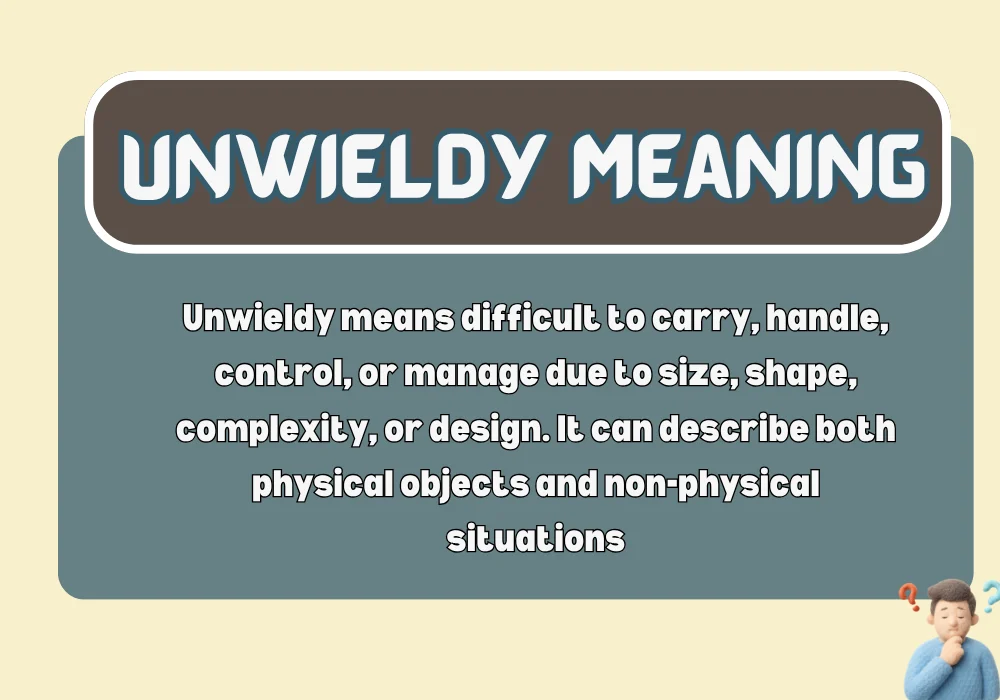
Unwieldy means difficult to carry, handle, control, or manage due to size, shape, complexity, or design. It can describe both physical objects and non-physical situations.
At its core, unwieldy refers to something that is awkward or inconvenient to deal with.
Origin and Background
The word unwieldy comes from combining:
- Un meaning not
- Wieldy meaning easy to handle or control
So unwieldy literally means not easy to handle.
Historically, the term was used to describe heavy weapons or tools that were hard to use in battle. Over time, its meaning expanded to include anything that feels difficult to manage.
Different Meanings of Unwieldy Based on Context
Unwieldy as a Physical Description
Unwieldy is often used to describe objects that are large, heavy, or awkward in shape.
Examples include:
- A large, unwieldy suitcase
- An unwieldy piece of furniture
- A long and awkward tool
These objects are not necessarily broken, but they are hard to move or use comfortably.
Unwieldy in Systems and Processes
Unwieldy can describe systems, plans, or structures that are too complex or inefficient.
Examples:
- An unwieldy company structure
- A complicated and unwieldy process
- An overly detailed report
In this sense, unwieldy means difficult to manage or understand.
Unwieldy in Communication and Writing
Sometimes unwieldy describes language that is too long, confusing, or poorly organized.
Examples:
- An unwieldy sentence
- A complex explanation that is hard to follow
Here, unwieldy suggests lack of clarity or simplicity.
Unwieldy Meaning in Simple Language
In everyday terms, unwieldy can mean:
- Hard to handle
- Difficult to control
- Too big or complicated
- Awkward to use
It often describes something that could work better if it were simpler or smaller.
Examples of Unwieldy in Conversations
Physical Object Example
This box is too unwieldy to carry alone.
Workplace Example
The system is so unwieldy that it slows down productivity.
Writing Example
That paragraph feels unwieldy and needs to be simplified.
Everyday Situation Example
The new software is powerful but a bit unwieldy to use.
These examples show how the word applies to different areas of life.
Unwieldy Compared to Similar Words
Understanding unwieldy becomes easier when compared with related terms.
| Word | Meaning | Key Difference |
|---|---|---|
| Unwieldy | Hard to handle or manage | Can be physical or abstract |
| Awkward | Not smooth or comfortable | Often about movement or behavior |
| Bulky | Large and heavy | Focuses on size |
| Complicated | Hard to understand | Focuses on complexity |
| Clumsy | Lacking coordination | Usually describes people |
Unwieldy often combines size, weight, and complexity.
Why Things Become Unwieldy
Many things become unwieldy over time due to:
- Poor design
- Too many features or steps
- Lack of organization
- Growth without proper structure
For example:
A small system may work perfectly at first, but as more features are added, it can become unwieldy and difficult to manage.
How to Deal With Unwieldy Situations
If something feels unwieldy, you can often improve it by:
- Simplifying the structure
- Breaking it into smaller parts
- Removing unnecessary elements
- Improving organization
Example:
Turning a long unwieldy document into shorter sections makes it easier to read.
Common Mistakes or Misunderstandings
Thinking Unwieldy Means Broken
Unwieldy does not mean something is damaged. It means it is difficult to use or manage.
Using Unwieldy Only for Physical Objects
The word also applies to systems, ideas, and processes.
Confusing Unwieldy With Complicated
While similar, unwieldy often includes physical difficulty or practical inconvenience, not just complexity.
Unwieldy in Modern Usage
Today, unwieldy is commonly used in:
- Technology discussions
- Business and management
- Product reviews
- Writing and editing
Example:
Users often complain when apps become too unwieldy after too many updates.
Related Words and Expressions
When learning the unwieldy meaning, you may also encounter:
- Cumbersome
- Bulky
- Complicated
- Inefficient
- Overloaded
Each word highlights a different aspect of difficulty.
FAQs:
What does unwieldy mean in simple words?
Unwieldy means something is hard to handle, control, or manage.
Can unwieldy describe non-physical things?
Yes, it can describe systems, processes, or ideas that are difficult to manage.
Is unwieldy always negative?
Mostly yes, because it suggests inconvenience or difficulty.
What is the opposite of unwieldy?
The opposite of unwieldy is manageable, simple, or easy to handle.
Can unwieldy be used in writing?
Yes, it is often used to describe sentences or paragraphs that are too long or complex.
Conclusion:
The unwieldy meaning highlights the idea of difficulty in handling, managing, or controlling something. Whether it is a heavy object, a complicated system, or a long piece of writing, unwieldy describes situations where things feel awkward or inefficient.
By understanding how unwieldy works in different contexts, you can use the word more effectively and identify ways to simplify or improve challenging situations.

John is the founder and primary content creator of Worlyz. He has a strong passion for explaining word meanings, language concepts, slang terms, and educational topics in a clear and simple way. John focuses on creating well researched, reader friendly content that helps users easily understand complex words and ideas. Through Worlyz, his goal is to make learning meanings and concepts straightforward and accessible for everyone.