The word abridge is often seen in books, education, and formal writing, but many people are unsure about its exact meaning. You might come across it when reading about shortened versions of novels or when someone talks about reducing content without losing its main message. Understanding the abridge meaning helps you use the word correctly and recognize it in both academic and everyday contexts.
Although abridge sounds formal, its concept is very simple and useful. Whether you are summarizing a story, editing content, or explaining something briefly, abridge plays an important role in communication.
What Does Abridge Mean
Definition
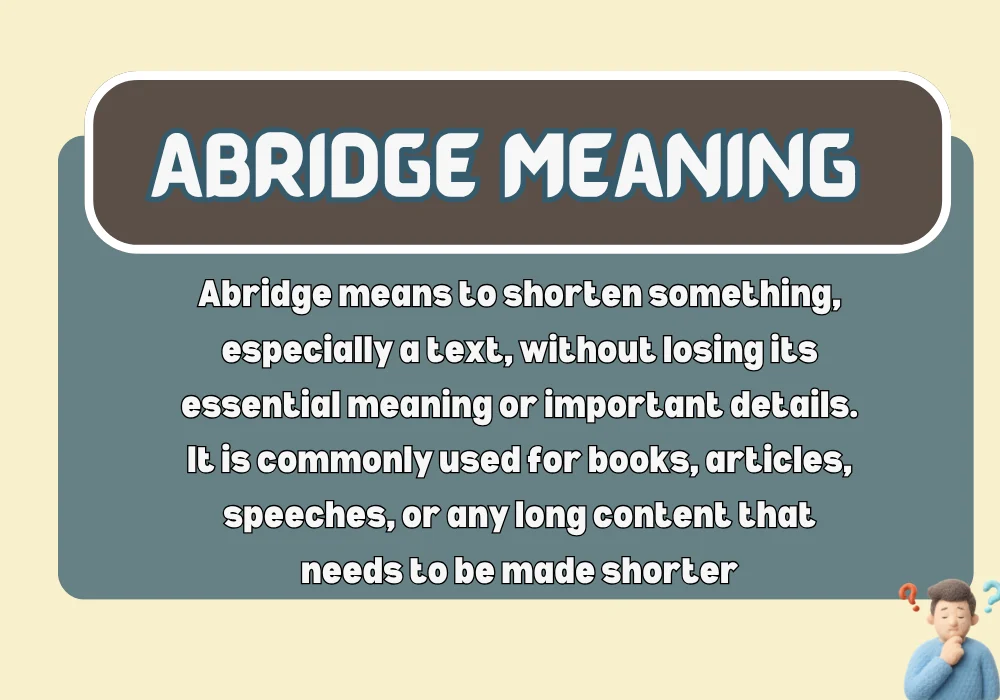
Abridge means to shorten something, especially a text, without losing its essential meaning or important details. It is commonly used for books, articles, speeches, or any long content that needs to be made shorter.
In simple terms, to abridge something is to cut it down while keeping the core message intact.
Origin and Background
The word abridge comes from the Old French word abregier, which means to shorten. It originally developed from Latin roots related to making something brief.
Over time, abridge became widely used in literature and education, especially when referring to shortened versions of long works like novels or historical texts.
Different Meanings of Abridge Based on Context
Abridge in Literature
In literature, abridge is most commonly used when a long book is shortened.
Examples:
- An abridged version of a novel
- A shortened textbook for students
- Simplified editions of classic literature
In this context, the goal is to keep the main story while removing less important details.
Abridge in Writing and Communication
Writers often abridge content to make it clearer or more concise.
Examples:
- Shortening an article
- Editing a speech
- Condensing a report
This helps readers understand the message quickly without unnecessary information.
Abridge in Legal or Formal Contexts
In formal or legal language, abridge can mean to reduce or limit something, such as rights or freedoms.
Example:
The law should not abridge basic rights.
This usage is less common in everyday conversation but important in formal writing.
Abridge Meaning in Simple Language
In everyday terms, abridge means:
- To make something shorter
- To remove extra details
- To keep only the important parts
It focuses on clarity and efficiency, not just cutting content randomly.
Examples of Abridge in Conversations
Academic Example
The teacher asked us to abridge the chapter into a one-page summary.
Reading Example
I prefer the abridged version because it is easier to understand.
Professional Example
We need to abridge this report before presenting it.
Casual Example
Can you abridge that story and tell me the main point?
These examples show how abridge is used in both formal and everyday situations.
Abridge Compared to Similar Words
Understanding abridge becomes clearer when compared with similar terms.
| Word | Meaning | Key Difference |
|---|---|---|
| Abridge | Shorten without losing meaning | Keeps main idea intact |
| Summarize | Give a brief overview | More general |
| Condense | Make more compact | Focus on reducing size |
| Shorten | Make something shorter | Less specific |
| Edit | Improve or revise content | Not always about length |
Abridge is more specific because it focuses on shortening while preserving meaning.
Why Abridging Is Important
Abridging is useful in many areas of life:
Education
Students abridge content to:
- Understand complex topics
- Prepare notes
- Save time while studying
Writing and Content Creation
Writers abridge to:
- Improve readability
- Keep content focused
- Remove unnecessary details
Communication
People abridge information to:
- Speak clearly
- Share ideas quickly
- Avoid overwhelming others
Common Mistakes or Misunderstandings
Thinking Abridge Means Cutting Everything
Abridge does not mean removing too much. The main idea must remain clear.
Confusing Abridge With Summary
A summary gives a general idea, while abridging keeps structure but reduces length.
Using Abridge in Casual Contexts Incorrectly
In casual speech, people often use words like shorten instead of abridge.
Abridge in Modern Usage
Today, abridge is commonly used in:
- Books and publishing
- Educational content
- Online articles
- Scripts and speeches
You may also see labels like:
- Abridged edition
- Abridged version
These indicate that the content has been shortened.
Related Words and Concepts
When learning the abridge meaning, you may also come across:
- Summary
- Condensed version
- Edited version
- Simplified text
- Brief explanation
Each has a slightly different use but shares the idea of reducing content.
FAQs:
What does abridge mean in simple words?
Abridge means to shorten something while keeping its main meaning.
What is an abridged version of a book?
An abridged version is a shorter form of a book that keeps the main story but removes extra details.
Is abridge the same as summarize?
No, abridge keeps the structure of the original, while summarize gives a general overview.
Can abridge be used in everyday conversation?
Yes, but it is more common in formal or academic contexts.
Why is abridging useful?
Abridging helps save time, improve clarity, and make content easier to understand.
Conclusion:
The abridge meaning is all about shortening content without losing its core message. It is a valuable concept in education, writing, and communication, helping people focus on what truly matters.
By understanding how to abridge effectively, you can improve your reading, writing, and ability to share ideas clearly in both formal and everyday situations.

John is the founder and primary content creator of Worlyz. He has a strong passion for explaining word meanings, language concepts, slang terms, and educational topics in a clear and simple way. John focuses on creating well researched, reader friendly content that helps users easily understand complex words and ideas. Through Worlyz, his goal is to make learning meanings and concepts straightforward and accessible for everyone.