The word discrete is commonly used in education, mathematics, technology, writing, and everyday conversations. Even though it looks similar to the word “discreet,” the meanings are completely different, which often causes confusion. Understanding the discrete meaning helps you use the word correctly and avoid one of the most common English language mistakes.
From academic subjects to simple descriptions, discrete appears in many contexts. This guide explains the meaning of discrete in simple language, including examples, comparisons, and modern usage.
What Does Discrete Mean
Definition
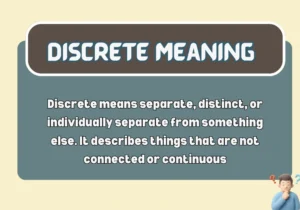
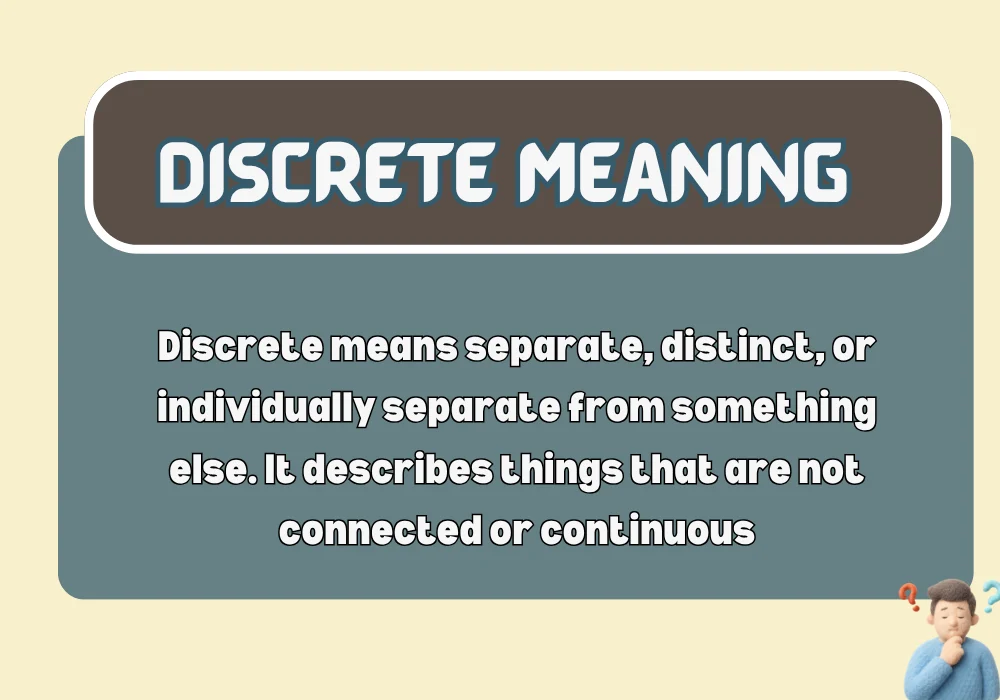
Discrete means separate, distinct, or individually separate from something else. It describes things that are not connected or continuous.
In simple words, discrete refers to something existing as its own separate unit.
Examples:
- Separate categories
- Individual objects
- Distinct pieces of information
Origin of the Word
The word discrete comes from the Latin word discretus, meaning separated or divided. Over time, it entered English to describe things that are individually distinct and not blended together.
Its spelling is often confused with “discreet,” but the meanings are very different.
Discrete Meaning in Simple Language
In everyday language, discrete means:
- Separate from others
- Individually distinct
- Not connected continuously
Think of discrete as describing things that can be counted or separated clearly.
Example:
The report divides the information into discrete sections.
How Discrete Is Used in Different Contexts
Discrete in Everyday Conversation
People use discrete to describe separate parts or individual items.
Example:
The project has three discrete stages.
This means the stages are separate and clearly divided.
Discrete in Mathematics
In math, discrete refers to values that are separate and countable rather than continuous.
Examples:
- Whole numbers
- Individual data points
- Discrete variables
For example:
You can count 1, 2, 3 individually, making them discrete numbers.
Discrete in Technology and Science
In technology, discrete can describe separate components or systems.
Examples:
- Discrete graphics card
- Discrete signal
- Discrete electronic components
This means the part works independently instead of being integrated into another system.
Discrete in Writing and Communication
Writers often use discrete to organize information into separate topics or categories.
Example:
The article discusses three discrete ideas.
Discrete Compared to Similar Words
Understanding discrete becomes easier when compared with related words.
| Word | Meaning | Key Difference |
|---|---|---|
| Discrete | Separate and distinct | Focuses on separation |
| Continuous | Unbroken and connected | Opposite of discrete |
| Independent | Free from outside control | Not always separate |
| Distinct | Clearly different | Broader meaning |
| Discreet | Careful or private | Completely different word |
This comparison helps prevent confusion between similar-looking terms.
Discrete vs Discreet
One of the biggest English mistakes is mixing up discrete and discreet.
Discrete
Means separate or distinct.
Example:
The machine has several discrete parts.
Discreet
Means careful, private, or subtle.
Example:
She was discreet about the conversation.
A simple memory trick:
- Discrete has “t” for things separated into parts
- Discreet has double “ee” like keeping a secret between two eyes
Examples of Discrete in Conversations
Everyday Example
The presentation covered several discrete topics.
Academic Example
Discrete mathematics focuses on separate values rather than continuous ones.
Technology Example
My laptop uses a discrete graphics card for gaming.
Workplace Example
The company divided tasks into discrete responsibilities.
These examples show how versatile the word is.
Common Mistakes or Misunderstandings
Confusing Discrete With Discreet
This is the most common mistake because the words look and sound similar.
Thinking Discrete Means Small
Discrete means separate, not tiny or minor.
Using Discrete in Emotional Contexts
Discrete usually fits logical or structured discussions more than emotional conversations.
Where Discrete Is Commonly Used
The word discrete is common in:
- Mathematics
- Computer science
- Engineering
- Academic writing
- Data analysis
- Technical discussions
It appears more often in formal or educational settings than casual slang.
Related Words and Concepts
When learning the discrete meaning, you may also encounter:
- Distinct
- Separate
- Independent
- Individual
- Continuous
These words are closely related depending on context.
FAQs:
What does discrete mean?
Discrete means separate, distinct, or individually separate from something else.
Is discrete slang?
No, discrete is not slang. It is a formal English word commonly used in education, technology, and writing.
Where is discrete used?
Discrete is commonly used in mathematics, science, technology, academic writing, and professional communication.
What does discrete mean in chat?
In chat, discrete usually keeps its standard meaning of separate or distinct. However, many people accidentally confuse it with discreet.
What is the difference between discrete and discreet?
Discrete means separate or distinct, while discreet means careful, private, or subtle.
Conclusion:
The discrete meaning centers around the idea of separation, distinction, and individuality. Whether used in mathematics, technology, writing, or everyday communication, discrete describes things that exist as separate parts rather than one continuous whole.
Understanding the difference between discrete and discreet is especially important because these words are commonly confused. By learning how discrete works in different contexts, you can use the word more accurately and confidently in conversations and writing.

Hi, I’m Mike Grobgaard, founder of Lexonr. I write about meanings, internet slang, biblical terms, and modern expressions in a simple yet engaging way. My goal is to help readers understand the deeper story behind every word they search for.