The word assent is commonly used in formal writing, discussions, and everyday conversations where agreement or approval is involved. Although it may seem similar to words like agreement or consent, assent has its own specific meaning and tone. Understanding the assent meaning helps you use it correctly in both spoken and written English.
Whether you see it in books, legal contexts, academic writing, or conversations, assent is an important word that expresses approval or acceptance in a clear but sometimes subtle way.
What Does Assent Mean
Definition
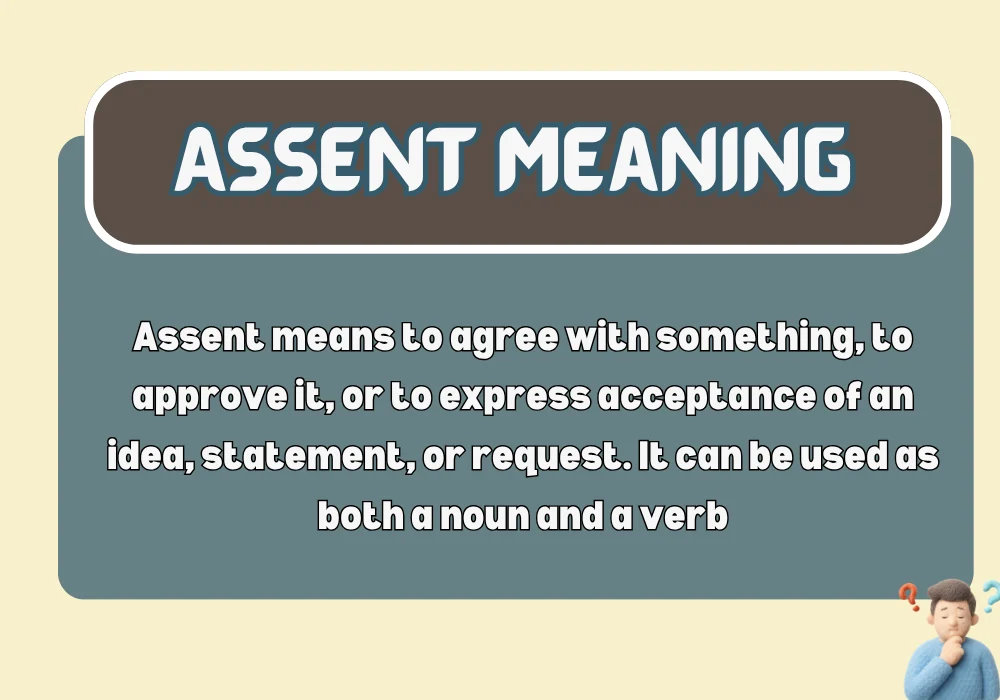
Assent means to agree with something, to approve it, or to express acceptance of an idea, statement, or request. It can be used as both a noun and a verb.
- As a noun: it refers to agreement
- As a verb: it means to express agreement
At its core, assent is about giving approval or saying yes, often in a calm or formal way.
Origin and Background
The word assent comes from the Latin word assentire, which means to agree or feel the same way. Over time, it became part of English vocabulary, mainly used in formal or structured communication.
Because of its origin, assent often sounds more thoughtful and deliberate compared to casual words like yes or okay.
Different Meanings of Assent Based on Context
Assent in Everyday Language
In daily conversations, assent simply means agreeing with someone.
Examples:
- She nodded in assent
- He gave his assent to the plan
This type of assent is often expressed through gestures like nodding or short verbal responses.
Assent in Formal or Legal Contexts
In legal or official settings, assent refers to formal approval or authorization.
Examples include:
- Royal assent given to laws
- Assent in contracts or agreements
In these contexts, assent carries more weight and often has legal importance.
Assent in Social and Communication Contexts
Assent can also describe how people respond in conversations to show they are listening or agreeing.
Examples:
- Saying yes during a discussion
- Nodding while someone is speaking
This type of assent helps maintain smooth communication.
Assent Meaning in Simple Language
In everyday terms, assent means:
- Agreeing with someone
- Accepting an idea
- Showing approval
It is usually polite, calm, and sometimes subtle rather than strong or emotional.
Examples of Assent in Conversations
Casual Conversation Example
He nodded in assent when she suggested the idea.
Formal Context Example
The proposal received official assent from the committee.
Social Interaction Example
She gave a quiet assent during the meeting.
These examples show how assent fits different tones and situations.
Assent Compared to Similar Words
Understanding assent becomes easier when compared with similar terms.
| Word | Meaning | Key Difference |
|---|---|---|
| Assent | Agreement or approval | Often formal or subtle |
| Consent | Permission | Stronger and more official |
| Agree | Accept an idea | More general and common |
| Approve | Official acceptance | More authoritative |
| Accept | Receive or agree | Broader meaning |
Assent is often quieter and less forceful than words like consent or approve.
How Assent Is Expressed
People express assent in different ways depending on the situation.
Verbal Ways
- Yes
- Okay
- I agree
- That makes sense
Non-Verbal Ways
- Nodding
- Smiling
- Maintaining eye contact
Sometimes assent is shown without words at all.
Common Mistakes or Misunderstandings
Confusing Assent With Consent
Assent means agreement, while consent often involves permission and legal or ethical importance.
Thinking Assent Is Always Verbal
Assent can be silent, such as a nod or gesture.
Using Assent in Casual Situations
In very casual conversations, assent may sound too formal compared to simple words like yes.
Assent in Formal Writing and Speech
Assent is commonly used in:
- Academic writing
- Legal documents
- Professional communication
- Public speaking
Using assent in these contexts adds clarity and formality.
Related Words and Concepts
When learning the assent meaning, you may also encounter:
- Agreement
- Approval
- Consent
- Acceptance
- Confirmation
Each word has a slightly different tone and level of formality.
FAQs:
What does assent mean in simple words?
Assent means agreeing with something or showing approval.
Is assent the same as consent?
No, assent means agreement, while consent involves giving permission, often in a formal or legal sense.
Can assent be non-verbal?
Yes, assent can be shown through gestures like nodding or facial expressions.
Where is assent commonly used?
Assent is often used in formal writing, legal contexts, and professional communication.
Can assent be used in daily conversation?
Yes, but it is less common in casual speech compared to simpler words like agree or yes.
Conclusion:
The assent meaning centers around agreement, approval, and acceptance. It is a versatile word used in both everyday and formal situations, often expressing a calm and thoughtful form of agreement.
By understanding how assent differs from similar words and how it is used in different contexts, you can communicate more clearly and choose the right tone for each situation.

John is the founder and primary content creator of Worlyz. He has a strong passion for explaining word meanings, language concepts, slang terms, and educational topics in a clear and simple way. John focuses on creating well researched, reader friendly content that helps users easily understand complex words and ideas. Through Worlyz, his goal is to make learning meanings and concepts straightforward and accessible for everyone.