The phrase not retained is commonly encountered in education, workplaces, legal documents, and everyday communication. Although it seems simple, its meaning can vary depending on the context. Understanding the not retained meaning helps you interpret information correctly and communicate more clearly, especially in formal or professional settings.
The phrase is often used to indicate that something — a fact, employee, memory, or item — was not kept, remembered, or continued. This guide explains the term in detail, with examples, comparisons, and practical applications.
What Does Not Retained Mean
Definition
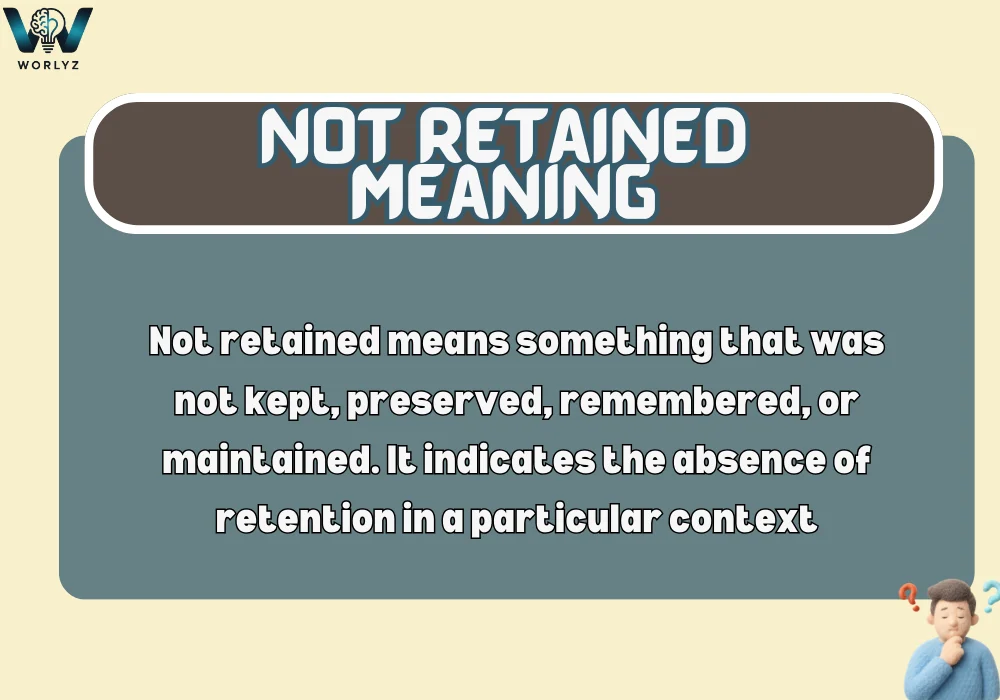
Not retained means something that was not kept, preserved, remembered, or maintained. It indicates the absence of retention in a particular context.
Depending on the situation, it can refer to:
- Information that is forgotten or not memorized
- Employees who are not kept in a company
- Items or records that were not preserved
- Skills or knowledge that were not maintained
Essentially, if something is “not retained,” it is lost, discarded, or no longer continued.
Origin and Background
The term “retained” comes from the Latin word retinere, meaning “to hold back” or “to keep.” The negative form “not retained” simply indicates the opposite — that something was not held, kept, or remembered.
The phrase is widely used in formal writing, technical documentation, HR policies, and educational contexts, which is why its precise meaning matters in professional communication.
Different Meanings of Not Retained Based on Context
Not Retained in Education
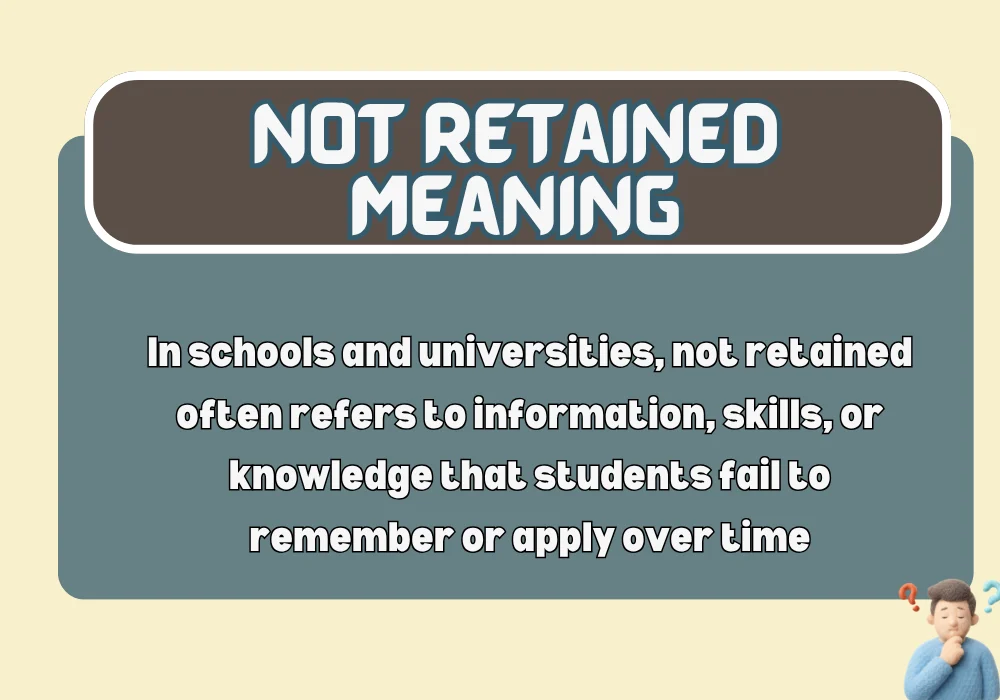
In schools and universities, not retained often refers to information, skills, or knowledge that students fail to remember or apply over time.
Examples:
- The formula was taught last week but not retained by the students.
- Facts that are not retained tend to fade quickly from memory.
In this context, the phrase emphasizes the importance of review and repetition to improve learning.
Not Retained in Employment or HR
In workplaces, not retained may describe employees who were not kept after a probationary period, project, or contract.
Examples:
- Three temporary staff were not retained after the project ended.
- Employees who do not meet performance standards may not be retained.
Here, it indicates a decision not to continue employment or involvement with an organization.
Not Retained in Legal or Official Documents
Legal documents, contracts, or official records sometimes use not retained to indicate that certain items, information, or records are not kept permanently.
Examples:
- Copies of the report are not retained for more than five years.
- This information is confidential and not retained in the public record.
In this case, the term emphasizes policy, procedure, or compliance rules.
Not Retained in Memory or Mental Context
The phrase can also refer to things that are forgotten or not remembered by individuals.
Examples:
- Details from the lecture were not retained by many students.
- After the accident, certain memories were not retained due to trauma.
This usage shows that not retained can describe natural mental processes as well as deficiencies in learning or recall.
Not Retained Meaning in Simple Language
In everyday terms, not retained can mean:
- Something that was lost or forgotten
- Someone or something that was not kept
- Information, skills, or items that were not maintained
The phrase usually implies absence, loss, or discontinuation, making it versatile across contexts.
Not retained meaning in job
Definition
In a job application process, not retained means that your application was not selected to move forward to the next stage of hiring.
What It Usually Means
- Your application was reviewed
- Another candidate was chosen instead
- You are no longer being considered for that position
Example
“After reviewing all applications, we regret to inform you that your profile was not retained.”
Not retained vs unsuccessful
Not Retained
- Usually refers to an application being screened out during recruitment.
- Often used by companies with formal hiring systems.
Unsuccessful
- A broader term meaning you did not get the job.
- Can apply at any stage of the hiring process.
Quick Comparison
| Term | Meaning |
|---|---|
| Not Retained | Not selected to continue in the process |
| Unsuccessful | Did not receive the job offer |
Key Difference
“Not retained” often focuses on the recruitment process, while “unsuccessful” refers to the overall outcome.
Your application was not retained
Meaning
If you receive a message saying “Your application was not retained,” it means the employer has decided not to proceed with your application.
Possible Reasons
- Strong competition from other candidates
- Skills did not fully match the role
- Limited number of interview slots
- Another applicant better fit the position
Important Note
This does not necessarily mean you were unqualified. It simply means you were not selected for the next stage.
Under consideration meaning
Definition
Under consideration means your application is still being reviewed by the employer.
What It Indicates
- You have not been rejected
- The hiring team is evaluating candidates
- A decision has not yet been made
Typical Status Progression
- Application received
- Under consideration
- Interview stage
- Offer or rejection
Good Sign?
Yes. Being under consideration generally means you are still in the running for the position.
Not retained Oracle meaning
Oracle Application Status
On the hiring platform of Oracle, Not Retained typically means your application is no longer being considered for that specific job opening.
What It Means
- The recruitment team reviewed your application
- You were not selected for the next stage
- The position may have been filled by another candidate
Can You Apply Again?
Yes. A “Not Retained” status usually applies only to that particular role and does not prevent you from applying for future opportunities.
Not retained after interview
Meaning After an Interview
If your status changes to Not Retained after an interview, it generally means you were considered for the role but were not chosen to continue or receive an offer.
Common Reasons
- Another candidate had more relevant experience
- Better alignment with the role’s requirements
- Limited openings available
- Hiring priorities changed
What to Do Next
- Continue applying for other opportunities
- Request feedback if the company allows it
- Use the interview experience to improve future applications
Key Takeaway
A “Not Retained” status after an interview means the selection process has ended for that position, but it does not reflect your overall professional value or future job prospects.
Examples of Not Retained in Conversations
Academic Example
The concepts taught in class were not retained by most students, so the teacher provided a review session.
Workplace Example
Two interns were not retained after their contracts ended because the company had no further openings.
Legal/Administrative Example
Customer data is not retained beyond 30 days to comply with privacy regulations.
Casual Example
I didn’t retain the recipe you shared, so I need it again.
These examples show how the phrase can be used in formal and informal situations.
Not Retained Compared to Similar Terms
| Word/Phrase | Meaning | Key Difference |
|---|---|---|
| Not retained | Something not kept, remembered, or maintained | Neutral, formal, and versatile |
| Lost | Something missing | Often accidental |
| Forgotten | Information not remembered | Focuses on memory |
| Dismissed | People or items removed | Often employment-related |
| Discarded | Deliberately thrown away | Implies intent |
While all these terms can overlap with not retained, the phrase is more formal and professional, especially in writing.
Common Mistakes or Misunderstandings
Assuming It Only Applies to People
Not retained does not only refer to employees. It can apply to information, memories, objects, or records.
Confusing It With “Removed” or “Deleted”
While removal or deletion may be intentional, not retained can simply mean something was not kept or preserved, whether intentionally or not.
Overusing It in Casual Conversation
The phrase is formal. In casual speech, words like “forgotten,” “lost,” or “didn’t keep” may be more natural.
Cultural and Professional Usage of Not Retained
The term is common in:
- Education reports and evaluations
- Human Resources policies
- Legal documents and contracts
- Administrative procedures
- Technical manuals and memory research
It emphasizes accuracy, clarity, and professionalism when describing absence, loss, or non-continuation.
Related Words and Expressions
When exploring not retained meaning, you may also encounter:
- Not remembered
- Not preserved
- Not kept
- Not maintained
- Not continued
Each carries a subtle nuance but generally conveys that something was not held or maintained over time.
FAQs:
What does not retained mean in simple words?
Not retained means something was not kept, remembered, or maintained.
Can not retained refer to people?
Yes, it is often used in workplaces to indicate employees who were not kept after probation, contracts, or projects.
Is not retained the same as forgotten?
Not always. Forgotten refers to memory loss, while not retained can also refer to objects, policies, or employment.
How is not retained used in legal documents?
It usually indicates that certain records, information, or items are not kept permanently to comply with regulations or policies.
Does not retained have a negative meaning?
Not necessarily. It depends on context — it can simply describe absence, non-continuation, or loss without judgment.
Conclusion:
The not retained meaning extends across multiple contexts, from education and work to law and memory. It can describe information, people, objects, or skills that were not kept, preserved, or continued.
Understanding the phrase helps you interpret formal documents, academic evaluations, workplace decisions, and even casual conversations accurately. Whether you’re reading a report, reviewing a memory, or discussing employment, knowing what not retained truly implies allows you to communicate with clarity and confidence.
By recognizing its different uses, you can apply the phrase appropriately and avoid confusion in professional, academic, or personal contexts.

Alex is the owner and founder of Worlyz. He is passionate about explaining word meanings, language concepts, slang terms, and educational topics in a clear and simple manner. Alex focuses on creating high quality, well researched, and user focused content that helps readers understand complex words easily. Through Worlyz, his goal is to make learning language meanings and concepts accessible and reliable for everyone.