The word besides is commonly used in everyday English, but many people still get confused about its exact meaning and correct usage. You might see it in conversations, writing, social media captions, or even formal communication. Understanding the besides meaning helps you use it naturally and avoid common grammar mistakes.
At first glance, besides may look like a simple word, but it actually has multiple meanings depending on context. It can act as a preposition or an adverb, and its tone can shift slightly based on how it is used. This detailed guide breaks everything down in a clear and practical way.
What Does Besides Mean
Definition
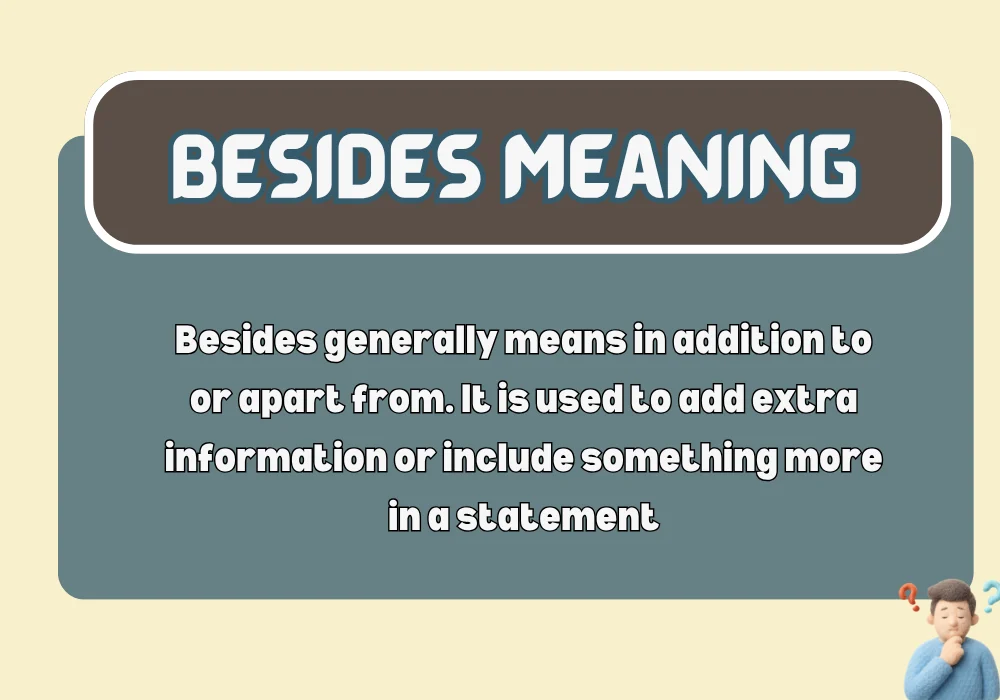
Besides generally means in addition to or apart from. It is used to add extra information or include something more in a statement.
In simple terms, besides helps you say:
- There is something extra
- There is more to consider
- Something else is also included
Origin and Background
The word besides comes from Old English roots where be meant by and sides referred to position or place. Over time, the meaning evolved to represent something that is along with or in addition to something else.
This evolution explains why besides is used to expand ideas rather than replace them.
Different Meanings of Besides Based on Context
Besides as In Addition To
This is the most common meaning. Besides is used to include something extra.
Examples:
- Besides English, she also speaks Spanish
- Besides work, he enjoys traveling
In this case, besides adds more information.
Besides as Apart From
Besides can also mean apart from or excluding something.
Examples:
- Besides him, no one knew the answer
- Besides this issue, everything is fine
Here, besides highlights what is included or excluded from a situation.
Besides as an Adverb in Conversation
Besides is often used at the beginning of a sentence to add a reason or argument.
Examples:
- I do not want to go. Besides, I am tired
- It is too late. Besides, we already made other plans
In this usage, besides strengthens your point.
Besides Meaning in Simple Language
In everyday terms, besides can mean:
- Also
- In addition
- On top of that
- Apart from that
It is a flexible word that helps connect ideas smoothly.
Examples of Besides in Conversations
Casual Conversation Example
Besides coffee, I also like tea.
Argument or Reasoning Example
We should not go out. Besides, it might rain.
Informal Text Example
Besides that, everything is going well.
Work or Study Example
Besides your main task, you need to complete this report.
These examples show how besides fits naturally in both casual and formal situations.
Besides Compared to Similar Words
Understanding besides becomes easier when compared with similar words.
| Word | Meaning | Key Difference |
|---|---|---|
| Besides | In addition or apart from | Flexible in use |
| Also | Adds information | More direct |
| Moreover | Adds emphasis | More formal |
| Apart from | Excluding or including | More specific |
| Additionally | Extra information | Formal tone |
Besides is more conversational and natural than many alternatives.
Besides vs Beside (Common Confusion)
Many people confuse besides with beside, but they have different meanings.
| Word | Meaning | Example |
|---|---|---|
| Besides | In addition to | Besides math, I study science |
| Beside | Next to | The book is beside the table |
Key point:
- Besides = about addition
- Beside = about position
How to Use Besides Correctly
In Sentences
- Use besides to add extra information
- Place it before nouns or at the beginning of a sentence
Examples:
- Besides homework, I have chores
- Besides, we already decided
In Writing and Speaking
Besides works well in:
- Casual conversations
- Essays and explanations
- Arguments and reasoning
It helps your sentences sound smooth and connected.
Common Mistakes or Misunderstandings
Confusing Besides with Beside
This is the most common mistake. Remember that besides is about addition, not position.
Using Besides Incorrectly in Formal Writing
While besides is acceptable, formal writing may prefer words like moreover or additionally.
Overusing Besides in One Paragraph
Using it too often can make writing repetitive.
Besides in Modern Communication
Today, besides is widely used in:
- Text messages
- Social media posts
- Emails
- Everyday conversations
Example:
Besides that, I think everything looks good
Its casual tone makes it popular in both spoken and written English.
Related Words and Expressions
When learning the besides meaning, you may also encounter:
- Also
- Too
- In addition
- Apart from
- Furthermore
Each has a similar function but slightly different tone.
FAQs:
What does besides mean in simple words?
Besides means in addition to or apart from something.
Is besides the same as also?
They are similar, but besides often adds more emphasis or explanation.
What is the difference between besides and beside?
Besides means in addition, while beside means next to.
Can besides start a sentence?
Yes, besides can be used at the beginning of a sentence to add a reason.
Is besides formal or informal?
Besides is generally informal but can be used in semi-formal writing.
Conclusion:
The besides meaning is simple once you understand its flexibility. It helps add information, strengthen arguments, and connect ideas naturally in both speech and writing. Whether used casually in conversation or in structured writing, besides plays an important role in clear communication.
By learning how to use besides correctly and avoiding common mistakes, you can improve your grammar and express your thoughts more effectively.

Alex is the owner and founder of Worlyz. He is passionate about explaining word meanings, language concepts, slang terms, and educational topics in a clear and simple manner. Alex focuses on creating high quality, well researched, and user focused content that helps readers understand complex words easily. Through Worlyz, his goal is to make learning language meanings and concepts accessible and reliable for everyone.